
Best rtwvacademyltd.com Alternatives for Christian Couples

For Christian couples in the U.S. looking for rtwvacademyltd.com alternatives, three options stand out: Couplesfightschool for clinician-designed intensives and the F.I.G.H.T. Plan® framework, RW Academy for structured Relational Wisdom training with cohort and self-paced tracks, and RTWtheacademy for community-based local programming. Here is the quick-reference shortlist:
- Couplesfightschool — Best for couples who want therapist-created courses, measurable communication milestones, and clinician-led intensives grounded in a named framework.
- RW Academy — Best for couples drawn to biblical peacemaking and relational wisdom skills, with flexible cohort or self-paced options.
- RTWV Academy Ltd. — Best for couples seeking a local, faith-focused counseling or coaching presence; availability varies by location.
- RTWtheacademy — Best for couples who prefer community-driven, event-based relationship support and local workshops.
The comparison table below breaks down format, faith emphasis, and outcomes side by side. The buying guide that follows explains exactly how to choose.
Table of Contents
- What are the best rtwvacademyltd.com alternatives for faith-based marriage education?
- How do you choose the right Christian marriage program or counselor?
- What do typical pricing and timelines look like by delivery format?
- What credentials should you look for in facilitators?
- What do past participants say about these programs?
- Key Takeaways
- Why clinician-designed, skills-first Christian programs produce real results
- Couplesfightschool offers clinician-designed courses and intensives right now
- Useful sources and further reading
What are the best rtwvacademyltd.com alternatives for faith-based marriage education?
| Couplesfightschool | RW Academy | RTWV Academy Ltd. | RTWtheacademy | |
|---|---|---|---|---|
| Best for | Clinician-led intensives, structured skill-building, Christian couples | Biblical peacemaking, ministry leadership extension, multi-track learners | Local faith-based counseling or coaching access | Community-based, event-driven relationship support |
| Delivery method(s) | Online courses, private coaching, workshops, intensives, workbooks | Interactive cohorts, 2-day virtual intensives, self-paced on-demand | Counseling and coaching (local/online; depth not publicly listed) | Local programs, community events, workshops |
| Faith-based emphasis | Christian-compatible; faith integrated through scripture-aligned conflict tools | Explicit biblical peacemaking; scripture woven into exercises and tracks | Christian marriage counseling and coaching focus | Community empowerment; faith orientation not prominently detailed |
| Format | Self-paced courses, cohort, intensive, private coaching | Cohort, self-paced, intensive (RW Coach / RW Conciliator tracks) | Coaching and counseling sessions | Event-driven, local programming |
| Outcomes / skills taught | Conflict resolution, emotional regulation, communication scripts, intimacy rebuilding | Relational wisdom, conflict with grace and truth, peacemaking skills | Faith-based counseling outcomes; specifics not publicly listed | Community relationship support; specific skills not publicly detailed |
Unique strengths and tradeoffs at a glance:
- RTWV Academy Ltd.: — Faith-focused counseling presence with a modest online footprint. Good for couples who want local or regional access; offerings and availability are not fully detailed publicly.
- RTWtheacademy: — Strong community orientation. Works well as a supplement or entry point, but couples seeking structured skills curricula will likely need something more.
How do you choose the right Christian marriage program or counselor?
The single most important rule: match the program’s credential level to the severity of what you’re facing. A structured education program works well for communication patterns and recurring conflict. When trauma, addiction, or serious mental health concerns are present, a licensed clinician is the starting point, not an elective.
Once you’ve made that call, here are the criteria that actually separate good programs from generic ones:
- Faith integration level. Faith-based programs vary widely. Some weave scripture directly into exercises and use biblical peacemaking as the organizing framework. Others keep faith references light. Decide how explicitly you want theology present before you enroll.
- Facilitator credentials. Licensed mental health professionals (LPCs, LMFTs, psychologists) bring clinical training that lay leaders do not. For conflict resolution frameworks to hold up under real pressure, the person who designed them matters.
- Format fit. Self-paced modules offer flexibility but require self-discipline. Cohorts and intensives build in external accountability, which tends to produce better follow-through. Private coaching is the highest-touch option.
- Measurable skills taught. Look for a named syllabus, specific communication milestones, or a framework with discrete steps. Programs built around general encouragement are harder to evaluate and harder to apply.
- Time commitment. A 2-day intensive demands a weekend. A cohort runs weeks. A self-paced course fits around your schedule but can stall without a deadline.
- Geographic availability. Most online programs are U.S.-wide. Local counseling or coaching depends on your region.
Questions to ask any provider before enrolling:
- Who designed the curriculum, and what are their credentials?
- Is faith integration explicit (scripture-based exercises) or general?
- What specific skills will we leave with?
- What format does this use, and how long does it take?
- Do you refer couples to licensed therapists when clinical issues arise?
- Is there a syllabus or session outline we can review?
Red flags to watch for:
- No named facilitator credentials anywhere on the site.
- Outcomes described only in vague terms (“stronger relationship,” “better communication”) with no concrete skill targets.
- No referral policy for clinical issues like trauma or addiction.
Pro Tip: If accountability is a challenge for you as a couple, choose a cohort or intensive over a self-paced module. Interactive cohorts typically yield higher engagement and real-world application because the schedule is set for you. Self-paced works best when both partners are already highly motivated and disciplined.
What do typical pricing and timelines look like by delivery format?

Pricing in faith-based relationship education tracks closely with format and credential level. These are general ranges based on how the market is structured, not figures specific to any single provider.
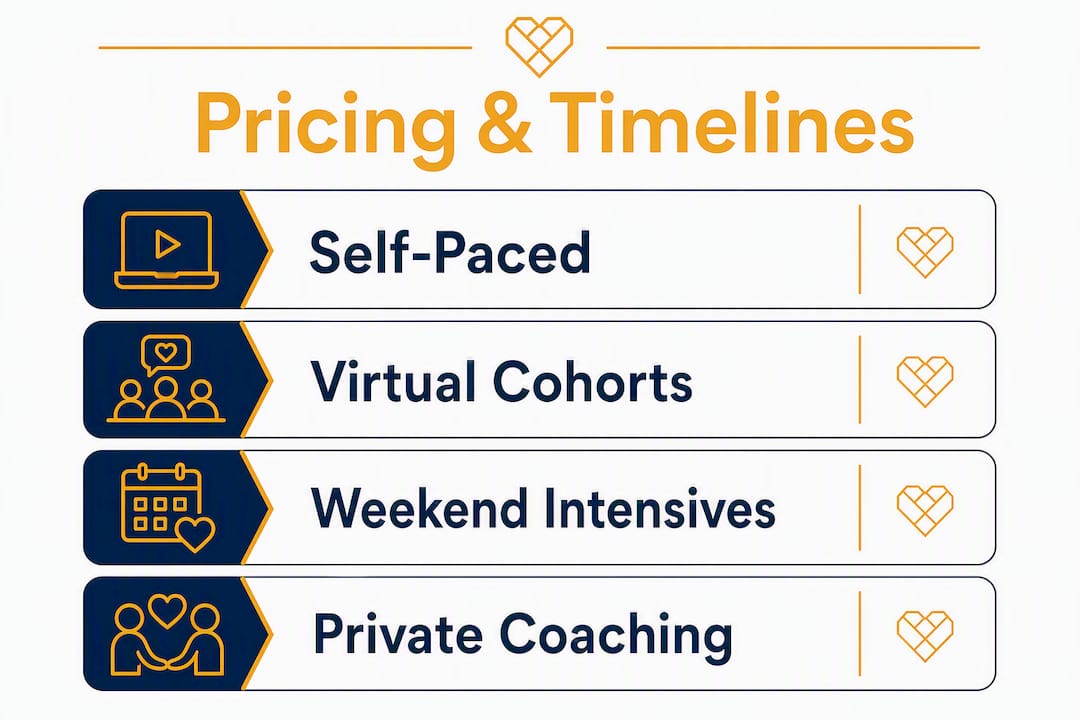
Self-paced online courses tend to be the most accessible entry point, typically running from a low one-time fee to a mid-range price depending on course depth and whether workbooks are included. Completion timelines are flexible, though most structured courses are designed for four to eight weeks.
Virtual cohorts carry a moderate price point and run on a fixed schedule, usually four to twelve weeks. The accountability structure justifies the higher cost for many couples.
2-day or weekend intensives (virtual or in-person) are priced at a premium relative to self-paced options, reflecting the concentrated facilitator time. They compress significant work into a short window, which suits couples who cannot commit to a multi-week program.
Private coaching is the highest-cost format, typically priced per session or as a package. It offers the most personalized attention and is the right fit when a couple needs real-time guidance rather than a structured curriculum.
What credentials should you look for in facilitators?
Credentials are the clearest signal of whether a program can handle what you bring to it. Couplesfightschool was founded by Carlos Todd and Natasha Pemberton-Todd, both licensed mental health professionals. That clinical foundation shapes every framework the platform uses, including the F.I.G.H.T. Plan®.
RW Academy structures its training around relational wisdom and biblical peacemaking. Its modular tracks (RW Coach, RW Conciliator) are designed for both personal growth and ministry leadership, which means facilitators and coaches in that system are trained within a specific theological and relational framework.
RTWV Academy Ltd. describes itself as a Christian marriage counseling and coaching provider. Specific facilitator credentials are not publicly listed in detail, so couples should ask directly before committing.
RTWtheacademy focuses on community empowerment and local programming. Facilitator credentials for relationship-specific content are not prominently detailed publicly.
For couples dealing with anything beyond communication patterns — infidelity recovery, trauma, addiction, or severe conflict — a licensed clinician is the appropriate starting point. Relationship education programs, however well-designed, are not substitutes for clinical therapy in those situations.
What do past participants say about these programs?
Public review data for this specific category of faith-based relationship education programs is limited. Couplesfightschool’s approach, built around the F.I.G.H.T. Plan® and clinician-designed curricula, reflects the kind of structured, skills-first design that practitioners consistently associate with better follow-through and measurable outcomes. The benefits of faith-based marriage counseling are well-documented in the broader literature, and programs with named frameworks and clear syllabi tend to earn stronger participant confidence than those built around general encouragement.
RW Academy’s community and cohort model generates engagement through its structured tracks and biblical peacemaking emphasis. Couples drawn to that theological framework tend to report that the explicit scripture integration is exactly what they were looking for.
For RTWV Academy Ltd. and RTWtheacademy, detailed public review data is not available. Both are worth a direct inquiry if local access or community programming is the priority.
Key Takeaways
For Christian couples in the U.S., the strongest rtwvacademyltd.com alternatives combine named clinical credentials, a clear faith integration approach, and a format that matches your schedule and accountability needs.
| Point | Details |
|---|---|
| Match credentials to your situation | Licensed clinician founders matter most when conflict is severe or clinical issues are present. |
| Choose format for accountability | Cohorts and intensives outperform self-paced modules for couples who need external structure. |
| Verify faith integration depth | Ask whether scripture is woven into exercises or just referenced generally before enrolling. |
| Prioritize upstream skills | Programs that teach conflict prevention, not just repair, produce more lasting change. |
| Couplesfightschool | Clinician-designed courses, intensives, and private coaching built around the F.I.G.H.T. Plan® — available across the U.S. |
Why clinician-designed, skills-first Christian programs produce real results
The most common mistake couples make when choosing a faith-based program is treating “Christian” as the only filter. It matters, but it is not sufficient on its own. I have seen couples complete programs that were deeply faith-centered and come away with beautiful spiritual language for their relationship and no actual change in how they fight. The reason is almost always the same: the program taught reflection and encouragement, not discrete skills.
What actually moves the needle is a program that teaches you something specific you can do differently the next time conflict starts. Not a principle to meditate on. A step. A script. A repair move you can execute under pressure. That is what structured frameworks like the F.I.G.H.T. Plan® are designed to deliver.
The other thing worth saying plainly: relationship education is not a replacement for clinical therapy. When trauma, addiction, or serious mental health concerns are in the room, a licensed clinician is the right first call. A well-designed education program can run alongside therapy, or follow it, but it should not substitute for it. Any program worth its reputation will tell you the same thing.
Couplesfightschool offers clinician-designed courses and intensives right now
If you want a program built by licensed mental health professionals, grounded in a named framework, and available across the U.S., Couplesfightschool is the direct answer. The Stop the Fighting course gives you a structured, therapist-created curriculum you can start immediately. For couples who want real-time, personalized guidance, online coaching connects you directly with a clinician-trained coach. Both options are built around the F.I.G.H.T. Plan® and designed to produce measurable communication skills, not just inspiration.
Book a coaching session or enroll in the course today at couplesfightschool.com.
Useful sources and further reading
- RTWtheacademy — Community empowerment programs and local events that may include relationship education components.
- RTWV Academy Ltd. site profile — Public SEO snapshot describing RTWV Academy’s faith-based counseling and coaching presence.
- Faith and marriage conflict resolution — Practical, faith-centered techniques for couples working through recurring conflict.
- Why Christian couples still struggle with conflict — Background on the specific challenges Christian couples face and why structured skills training helps.
- Benefits of faith-based marriage counseling — Explains how faith integration differs between providers and why it matters for program selection.
- How to use scripture for conflict resolution — Demonstrates what explicit scripture-based exercises look like in practice.
This article provides general educational information about relationship education programs and is not a substitute for professional mental health advice. If you are dealing with trauma, addiction, domestic violence, or severe mental health concerns, please consult a licensed clinician directly.
Recommended
- Alternatives to integrativecouplestherapy.com: Best Picks
- Top 4 DeeperConnecting.com Alternatives 2026
- StripeM-Inner