
Rupture and Repair in Marriage: How to Reconnect After a Fight
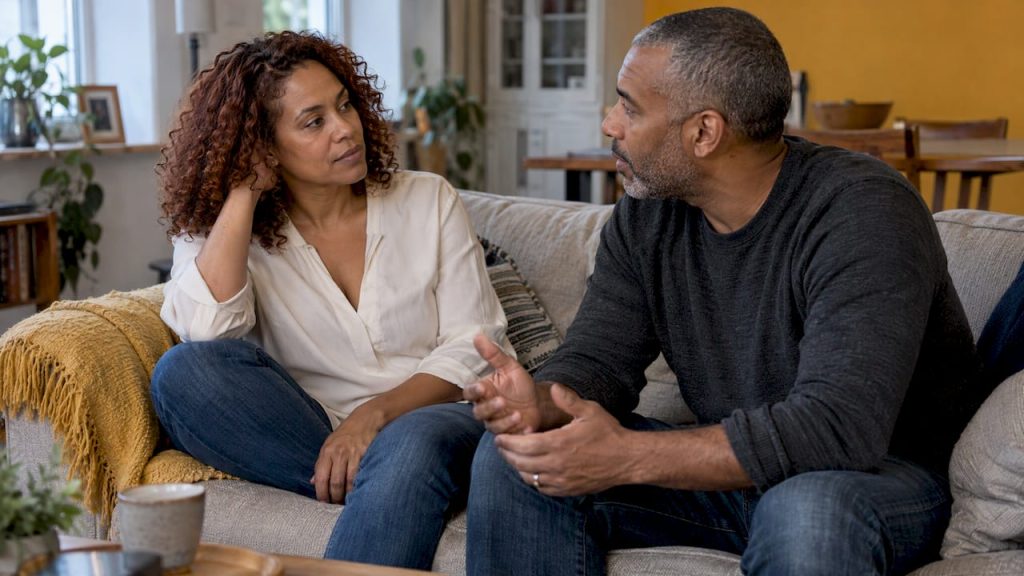
A rupture is any moment when you and your spouse lose connection: a harsh word, a dismissive sigh, a fight that went too far. Repair is what you do afterward to turn toward each other again. Ruptures are normal. What shapes a marriage is whether they get repaired, and repair is a skill you can learn. This guide covers what repair looks like, what to say, what to avoid, and what to do when the same fight keeps coming back.
TL;DR
- A rupture is a break in connection, and every close relationship has them. The damage comes from ruptures that are never repaired.
- Wait until you are both calm. Repair attempted while either of you is flooded can backfire.
- A real repair goes beyond “sorry”: it includes understanding your partner’s side, owning your part, and naming what you will do differently.
- Skip the “but.” It cancels everything you said before it.
- If the same fight repeats or repair keeps failing, that is the signal to get structured help.
Table of Contents
- What rupture and repair actually mean in a marriage
- Why timing decides whether repair works
- Repair attempt phrases you can use
- A five-part way to repair after a fight
- How to apologize so it actually repairs
- Perspective: what we see in couples who struggle to repair
- When the same fight keeps coming back
- When to bring in professional help
- Build the skill with Couples Fight School
- A short repair checklist to save
- FAQ
- Sources
What rupture and repair actually mean in a marriage
A rupture is a break in the connection between two people, often caused by hurt and anger, and it is a normal part of every relationship. The same source notes that repeated ruptures without repair can build walls, replace love with resentment and erode the relationship over time.
Repair is the other half. Psychiatrist Jerry M. Lewis, writing in the American Journal of Psychiatry, described relationships that help people grow as ones where a strong bond is formed and its inevitable disruptions are repaired. In his account, disruptions happen because nobody can be perfectly attuned to an important person all the time.
That is worth sitting with. A rupture does not mean you married the wrong person or that you are failing. It means two separate people with separate moods, stress loads and histories sometimes miss each other. The question is what happens next.
What ruptures look like in everyday life
Not every rupture is a screaming match. Common ones include:
- A sarcastic comment that lands harder than intended
- Checking your phone while your spouse is telling you about a bad day
- Forgetting something that mattered to them
- Going silent for hours after a disagreement
- A fight that escalates into criticism, contempt or defensiveness
Quiet ruptures matter as much as loud ones. Emotional distance that nobody names tends to harden. If this is your pattern, our guide on how to address unresolved resentment in marriage goes deeper.
Why timing decides whether repair works
The most common repair mistake is moving too fast. When you are still flooded, with a racing heart, tunnel vision and a head full of rebuttals, you cannot take in anything your partner says. Psychology Today’s Moshe Ratson describes repair as intentionally turning toward each other after conflict, and notes that timing matters, since trying when either person is emotionally flooded can backfire.
Utah State University’s Stronger Marriage program gives similar guidance: wait until the tension has died down, then talk, and apologize once both of you have cooled off.
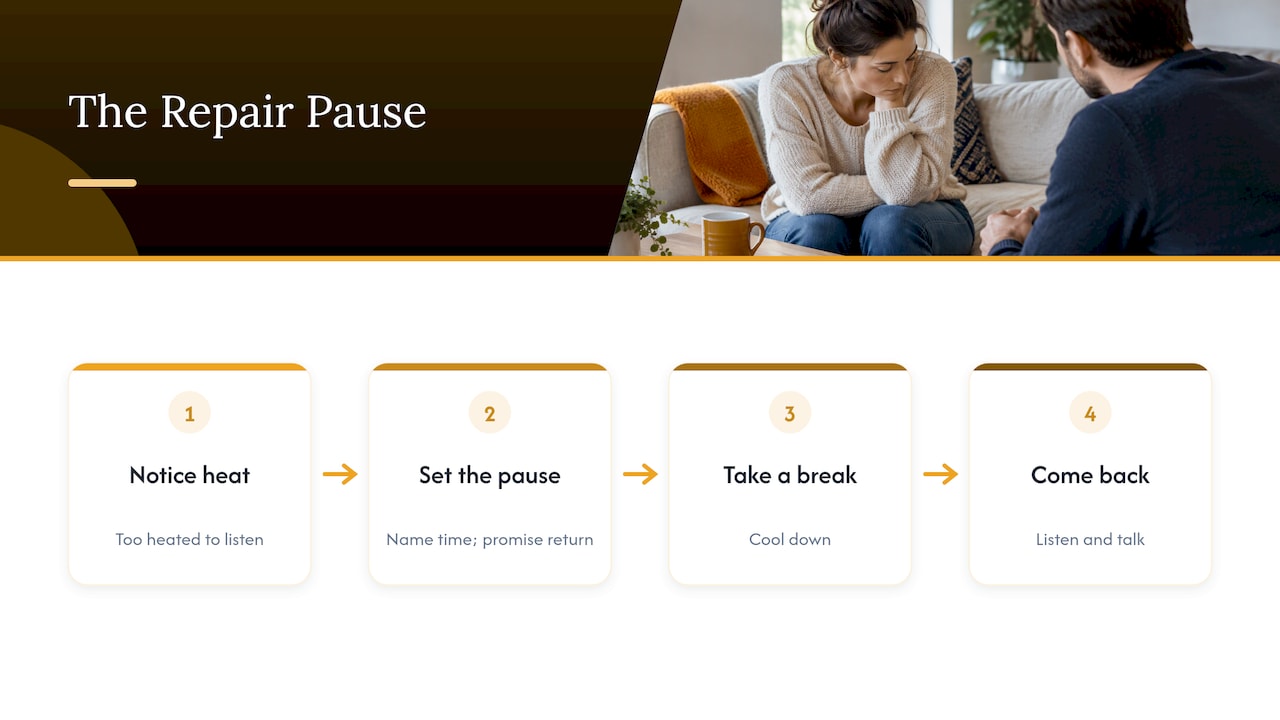
How long does cooling off take? It varies by person, and you will learn your own pattern. A useful rule: you are ready when you can hear your partner’s complaint without preparing a counterargument. If you want a structure for the pause itself, our time-out scripts for couples show how to call a break without it feeling like abandonment, and our guide to emotional flooding in marriage explains what is happening in your body.
Exhaustion makes flooding more likely. If you are in a season of sleepless nights with a new baby, this piece on new mom overwhelm helps explain why small things suddenly feel huge, and why a longer pause before talking may be wise.
The one rule for the pause
A break is not the silent treatment. Say how long you need and promise to return: “I’m too heated to listen well. I need twenty minutes, and then I want to talk about this.” Then actually come back. The return is what makes the pause a repair move instead of another rupture.
Repair attempt phrases you can use
A repair attempt is any statement or gesture that softens tension, de-escalates conflict or helps partners feel connected again, as Psychology Today describes it. It can be a sincere apology, a soft touch, a moment of vulnerability or a simple acknowledgment. Genuine gestures interrupt escalation and open space for healing.
Here are phrases that fit different moments. Adapt them to your own voice, because a script that sounds like you works better than one that does not.
During the fight
- “I didn’t say that the way I meant to. Let me try again.”
- “I’m getting really heated. Can we pause for a few minutes? I will come back.”
- “We’re both getting upset. Let’s slow down.”
- “I’m not hearing you well right now. Let me slow down and listen.”
Right after, when you want to acknowledge impact
- “I can see I hurt you, and I’m sorry.”
- “I didn’t realize how much that mattered to you.”
- “That wasn’t fair of me. I’m sorry I said it that way.”
Without words
A hand on the back, making tea for both of you, sitting beside your spouse instead of across from them. Nonverbal repair often goes first, especially for people who find words hard when upset. If your spouse is not ready, do not push. Offer once, gently, and give space.
For in-the-moment tools that work in seconds, see our de-escalation techniques.
A five-part way to repair after a fight
Several credible sources describe similar sequences. NPR’s Life Kit, featuring Baya Voce, lays out a five-step process for making amends, including what to do if you are still upset and making sure both people get to say what they feel and need. Here is a practical version that draws on those ideas.
- Calm down first. Take the break. Do something that lowers your body’s alarm, such as a walk, slow breathing or a shower. Do not rehearse your case.
- Open with commitment, not the grievance. Utah State’s guidance suggests sharing concerns in general terms, expressing commitment to the relationship, and asking how your partner feels. Try: “I love you and I don’t want this to sit between us. Can we talk?”
- Let your partner speak first, without judgment. Listen, nod, keep eye contact and repeat back what you heard. Check: “Did I get that right? What else?”
- Take your turn. Describe your experience using “I” statements about what you felt and needed, not a verdict on their character.
- Apologize and plan. Own your part and agree on one concrete change for next time.
Both people need a turn. A repair where only one person talks is a lecture, however polite.
How to apologize so it actually repairs
Psychology Today’s Rachel Diamond, Ph.D., argues that successful repair goes beyond apology and requires perspective-taking, accountability and a commitment to future change. Break that into three parts:
| Part | What it sounds like |
|---|---|
| Perspective-taking | “I can see how it felt when I walked out mid-sentence. You felt dismissed.” |
| Accountability | “That was on me. I was stressed and I shut down.” |
| Commitment to change | “Next time I’ll tell you I’m overwhelmed before it gets to that point.” |
The same article offers a model along these lines, with a promise to communicate stress ahead of time rather than take it out on a partner. Use your own specifics.
Three habits that undo an apology
- Explaining or defending first. The article advises against making excuses before the repair itself.
- Adding “but.” “I’m sorry, but you started it” discounts everything before the word.
- Demanding instant forgiveness. Your partner may need time. Give it.
We cover this in more detail in our piece on apology in marriage.
Perspective: what we see in couples who struggle to repair
We have worked with thousands of couples, and the pattern is rarely a lack of love. It is a lack of a plan for the minutes after a fight.
Most couples were never taught how to come back together. They either pretend nothing happened, which leaves resentment behind, or they reopen the argument too soon, which restarts it. Neither one is repair.
That is why we built the F.I.G.H.T. Plan® as a structured system for communication, emotional regulation and healing. It gives you steps instead of hoping the right words show up when you are upset. We designed it to be practical and skills-based, so you can start using it the same week.
If you take one thing from this article, take this: repair is not a sign your marriage is weak. It is the skill that keeps it strong. And skills get better with practice.
Carlos
When the same fight keeps coming back
Sometimes you apologize, make up, and two weeks later you are having the exact same argument. Diamond’s article addresses this: when an apology does not stop the pattern, repair should include committing to future changes and asking what could be done differently next time. Without that step, couples can end up in the same negative cycle again and again.
Ratson’s work on recurring conflicts makes a related point: for “perpetual problems,” how the disagreement is discussed matters most, including repairing with empathy, validation or apology when things escalate.
In practice, that means:
- Name the cycle, not just the topic. The dishes, the in-laws and the budget are often the same loop wearing different clothes. Our article on why couples repeat the same arguments walks through it, and eight escalation patterns couples repeat can help you spot yours.
- Ask the next-time question. “What could each of us do differently when this starts?” Write the answer down.
- Learn to disagree without a rupture. Some differences never fully resolve. See how to agree to disagree respectfully.
When to bring in professional help
The Australian Psychological Society advises that when relationship problems become a pattern and seem unable to be solved, it is important to seek help from someone experienced with relationship issues. A psychologist can help identify what is feeding the problems and how to address them.
You do not have to wait for a crisis. Psychology Today’s Tasha Seiter, PhD, LMFT, notes that couples therapy can be a proactive way to build skills before problems become overwhelming, and that starting earlier can lead to better outcomes.
Signs it is time to get support:
- Fights end with contempt, name-calling or threats to leave
- One or both of you avoid talking about important topics altogether
- Repair attempts are consistently rejected or ignored
- Trust has been broken, such as after an affair
If you ever feel afraid of your partner, or there is any physical violence, controlling behavior or intimidation, a repair conversation is not the right tool. Contact the National Domestic Violence Hotline at 1-800-799-7233 or a licensed mental health professional who can help you plan safely.
Build the skill with Couples Fight School
Reading about repair helps. Practicing it with a structure helps more. Our materials were created by licensed mental health professionals Carlos Todd and Natasha Pemberton-Todd and are built around the F.I.G.H.T. Plan®.

Where to start depends on where you are:
- A low-cost first step: The F.I.G.H.T. Plan workbooks and toolkit. The Couples Conflict Toolkit is $27, and the F.I.G.H.T. Plan workbook ranges from $14.99 to $25.00. Faith-centered, premarital and affair-recovery workbooks are also available, each from $9.99 to $20.00.
- A full course: Stop the Fighting: The Couples Communication & Conflict Resolution Course is $149.00. The Fight Less Love Again Video Course is $47.00.
- Personal guidance: VIP Private Coaching, four sessions is $997.00, and the 6 Hours Couples Intensive is $1995.
Prices are as published on our site and can change, so check the shop page for current details.
A short repair checklist to save
Next time a fight leaves you both raw, run through this:
- Am I flooded? If yes, pause and name when I will return.
- Have I come back calm enough to listen first?
- Did I start with commitment, such as “we matter,” rather than blame?
- Did I reflect back what my partner said before defending myself?
- Did I own my part without “but”?
- Did we agree on one thing to do differently next time?
You will not do all six perfectly every time. Nobody does. The goal is to get a little faster at coming back each time.
FAQ
How do you repair a marriage after a big fight?
Give yourselves time to calm down first, then reopen with a statement of commitment and an invitation to talk. Let your partner share their experience without interruption, share yours, and finish with an apology and one concrete change. If either of you is still flooded, pause again rather than push through.
What are good repair attempt phrases?
Short, sincere and specific work best: “Let me try that again,” “I’m getting heated, can we take a break?” or “I can see I hurt you, and I’m sorry.” Choose words that sound like you. A repair phrase only works if your tone matches it, so avoid sarcasm or a “but” that undoes it.
What if my spouse won’t accept my apology?
Give them time and avoid pressuring them to forgive on your schedule. Make sure your apology included understanding their perspective, owning your part and a specific commitment to change, since an apology that skips those can feel empty. If repair attempts are repeatedly rejected, consider working with a licensed couples therapist or coach.
How long should you wait before talking after an argument?
There is no fixed number. Wait until you can listen without preparing a rebuttal, which for many couples is from twenty minutes to a few hours. Tell your partner when you will come back so the break does not feel like withdrawal.
Sources
- When a Relationship Ruptures, Psychology Today
- Repairing the Bond in Important Relationships, American Journal of Psychiatry
- After the Fight: Four Perspectives and Skills for Rebuilding Emotional Intimacy, Utah State University Extension
- Mastering the Art of Relationship Repair, Psychology Today
- Turning a Fight Into a Connection, Psychology Today
- How to repair after a fight with your partner, NPR Life Kit
- When “I’m Sorry” Isn’t Enough: How Couples Can Repair, Psychology Today
- Solving Constant Conflicts in Relationships, Psychology Today
- Relationship problems, Australian Psychological Society
- When Is The Right Time for Couples Therapy?, Psychology Today
Recommended
- How to Deal With Issues in a Relationship Right Now
- How to Address Unresolved Resentment in Marriage
- 5 Step Rehearsal For Couples That Makes Fair Fighting Rules Stick
- Intimacy After Infidelity: How to Rebuild It, Step by Step