
Four Part Conflict Conversation Starters for Couples That Stop Fights

Open with a short, specific line that names the issue, states its impact on you in “I” language, and hands the floor to your partner. Conflicts](https://drconflicts.com/insights/how-to-start-a-difficult-conversation). A working example: “Can I bring something up? It’s about the dishes. I’ve been feeling unseen when I do them alone every night. Can we figure this out together?” Licensed mental health professionals have developed this pattern into a repeatable practice, not a one-time script.
TL;DR:
- Starting a conflict discussion in a private, low-stakes setting increases the likelihood of a productive exchange and reduces defensiveness.
- Using specific, behavior-based language and leading with your main point helps prevent misunderstandings and emotional escalation.
- Employing neutral, open-ended questions instead of leading or accusatory ones fosters understanding and reduces hostility.
- Pausing and requesting a restart during heated moments can prevent blame cycles and keep the conversation constructive.
- Repeated conflicts often signal deeper pattern issues and may require outside guidance rather than more willpower or better wording.
Table of Contents
- Conflict Conversation Starters Organized by What You’re Trying to Do
- How to Prepare and Deliver a Hard Conversation
- De-Escalation Phrases and Restart Scripts
- Red Flags That Mean It’s Time to Pause
- Adjusting Starters for Different Conflict Contexts
- Common Pitfalls That Sink a Conflict Conversation Before It Starts
- Real Examples of Ineffective Openers and Why They Backfire
- A Practitioner’s View on Making These Starters Stick
- Where to Get Structured Practice Beyond These Starters
- Sources
- FAQ
Conflict Conversation Starters Organized by What You’re Trying to Do
Most people reach for a conversation starter when they’re already upset, which is exactly the wrong moment to improvise. Having a small set of go-to lines, sorted by purpose, means you’re not scrambling for words while your heart rate climbs.
Openers name the topic and ask permission before diving in. Permission matters more than people think: it converts a surprise attack into an invited conversation, and invited conversations trigger far less defensiveness.
- “Can we talk about something that’s been bothering me? It’s about [topic], and I want us to work through it together.”
- “I noticed something and I want to check in. Is now an okay time?”
- “There’s a pattern I keep seeing, and I’d like your take on it.”
Curiosity and clarification prompts gather information instead of scoring points. The Program on Negotiation at Harvard recommends open-ended, neutral questions over leading ones, because a question like “Why would you even say that?” is really an accusation wearing a question mark. Compare that to:
- “Help me understand what was going on for you in that moment.”
- “What did you mean when you said that? I want to make sure I heard it right.”
- “How do you see this situation differently than I do?”
Solution-focused prompts shift the conversation from blame to options once both people feel heard. A government-published list of conflict-resolution questions from Minnesota offers a useful model here.
- “What would make this feel fair to both of us?”
- “If we could fix one part of this first, what should it be?”
- “What’s something we haven’t tried yet?”
Commitment and follow-up scripts turn a good conversation into an actual change. Without this step, couples often repeat the same fight because nothing got written down or agreed to out loud.
- “So we’re agreeing to [specific action]. Does that sound right to you?”
- “Let’s check back in on this in a week and see how it’s going.”
Pro Tip: Pick one starter from each category and say it out loud, alone, before you need it. Rehearsed lines come out steadier than improvised ones, especially when your adrenaline is up.
For couples who want more structured practice beyond these lines, six therapist-backed communication exercises offer a next step.
How to Prepare and Deliver a Hard Conversation
Timing decides more of the outcome than most people realize. A conversation started in the kitchen doorway, five minutes before someone leaves for work, is set up to fail regardless of how good the opener is.
- Pick a private, low-stakes time. A closed door and no audience lowers the odds of either partner going into performance mode or shutting down out of embarrassment.
- Lead with your takeaway, not your buildup. Say the conclusion first, then explain. Berkeley Executive Education recommends preparing your objective and opening with clarity rather than working up to the point through five minutes of preamble.
- Ask for consent to continue. “Can I say more about this?” keeps the conversation collaborative instead of one-sided.
- Use specific, behavior-based language. “You raised your voice at dinner” lands differently than “You’re always so hostile.”
- Avoid leading or loaded questions. Mediate points to three diagnostic questions worth memorizing: “How do you know that?”, “Compared to what?”, and “Who decides?” They redirect conflict from positions toward reasoning.
A four-part opener structure that includes frame, topic, impact, and invitation has been shown in practitioner settings to improve the odds a difficult conversation opens without triggering an immediate defensive spiral, per Dr. Conflicts. Rehearse your opening line three times before you say it out loud to your partner. It sounds unnecessary until you’re mid-sentence and realize you don’t know how to finish it.
De-Escalation Phrases and Restart Scripts
Even a well-built opener can go sideways. What you do in the next ten seconds decides whether the conversation recovers or spirals.
- “I want to understand, not win this.”
- “Let’s slow down. I don’t want to say something I’ll regret.”
- “Can we pause and come back to this in twenty minutes?”
- “That came out sharper than I meant. Let me try again.”
That last line, an explicit restart, works because it interrupts the automatic script both partners are running. Naming the moment and offering a redo signals repair instead of retreat, a pattern mediation practitioners point to as one of the more reliable ways to stop blame cycles mid-conversation.
Pro Tip: When you ask for a pause, always name a return time. “Give me twenty minutes” is a request for space. Silence with no return time feels like abandonment, even when that’s not the intent.
Couples looking for more structured phrases can work through the de-escalation tools built for couples, which expand on pause-and-return scripts in more depth.
Red Flags That Mean It’s Time to Pause
Some conversations aren’t ready to be finished, no matter how good your opener was.
- Contempt shows up as eye-rolling, sarcasm, or name-calling, and it tends to shut down any real listening.
- Stonewalling looks like one partner going silent, physically leaving, or refusing to engage at all.
- Threats, even vague ones about the relationship’s future, are a sign the conversation needs to stop immediately.
If the conversation ends without any of these signs, close it by writing down what you agreed to and setting a specific check-in time. If the same fight keeps resurfacing despite good-faith attempts, that repetition itself is the signal. It usually means the pattern needs outside structure, not more willpower, and that’s a reasonable moment to say: “I think we’d benefit from working with someone who can help us build a system for this.” Reviewing common escalation cycles couples repeat can help you spot the pattern before your next attempt.
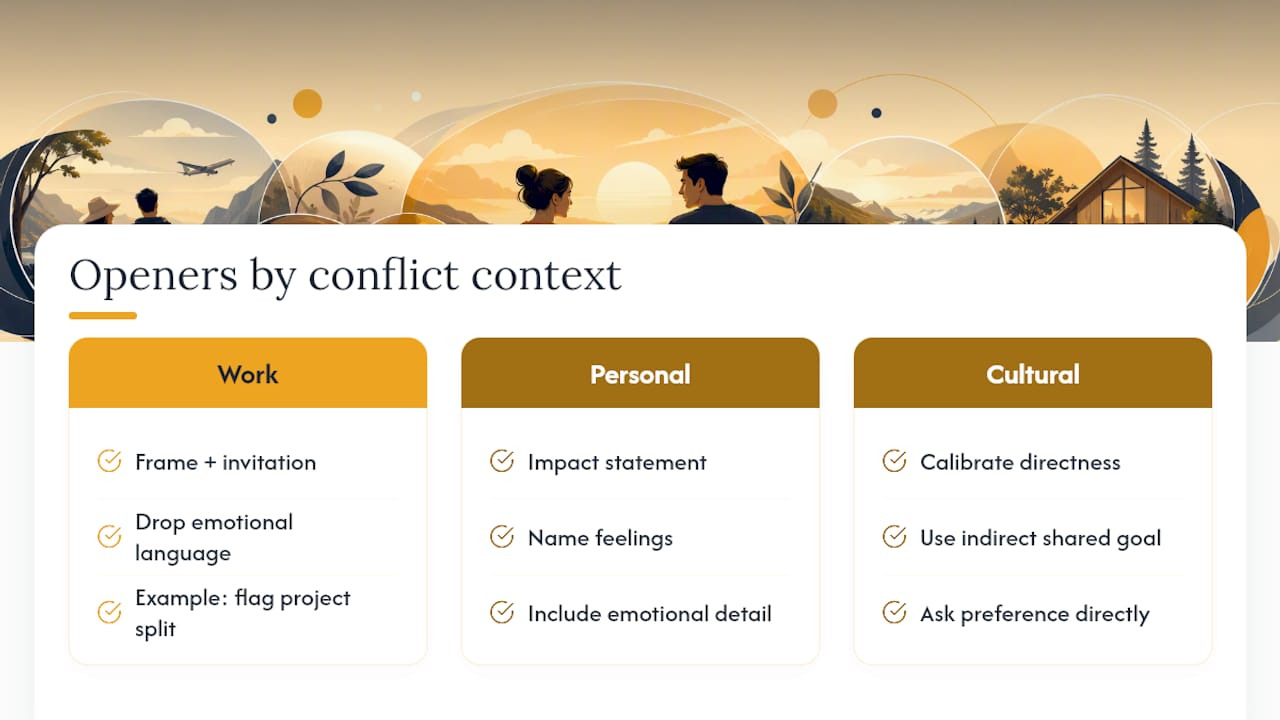
Adjusting Starters for Different Conflict Contexts
A starter that works at home can misfire at work, and one that works with a partner raised in the same culture as you might land wrong with someone raised differently.
At work, drop the emotional impact language and lean on the frame and invitation. “Can I flag something about how we split this project? I want to make sure we’re both clear on next steps” keeps things professional while still following the same structural logic.
In personal relationships, the impact statement carries more weight. Partners generally want to know how something affected you emotionally, not just logistically, so don’t skip that part the way you would at the office.
Across cultural differences, directness tolerance varies widely. Some cultural backgrounds treat a direct “I feel hurt when…” as clear and respectful; others read it as confrontational and prefer an indirect approach that raises the topic through a shared third point, like a mutual goal or value. If you’re not sure which your partner or colleague prefers, ask them directly: “Do you like it when I get straight to the point, or would you rather I ease into things?” That single question often prevents more misunderstanding than any opener could.
Common Pitfalls That Sink a Conflict Conversation Before It Starts
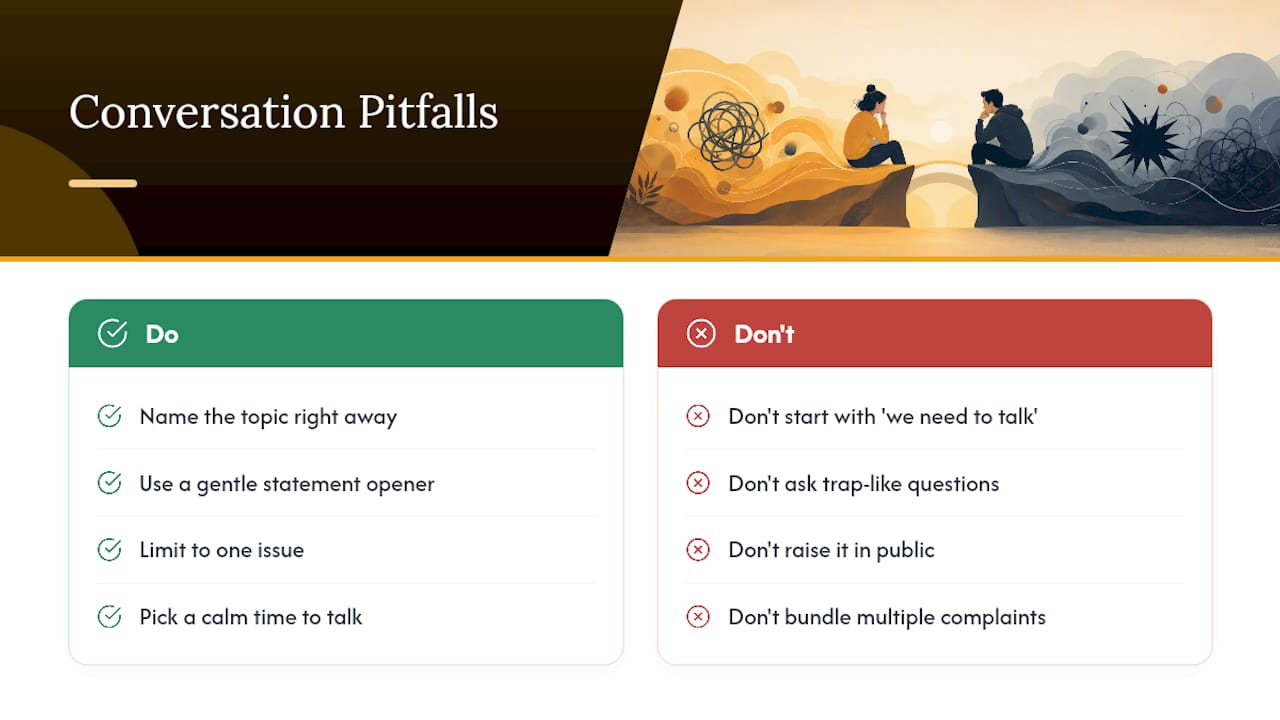
Most failed conversations don’t fail because of what was said in the middle. They fail in the first ten seconds.
Starting with “we need to talk” and nothing else creates dread without direction, leaving the other person to spiral through worst-case scenarios before you’ve even named the topic. Opening with a question instead of a statement, like “Do you ever think about how you talk to me?”, puts the other person on the defensive because it reads as a trap rather than an invitation. Bringing up the issue in front of other people, even close family, almost guarantees a defensive response, since nobody wants to be corrected publicly.
Another common pitfall: stacking multiple complaints into one opener. “While we’re talking, I also wanted to mention…” turns a focused conversation into an ambush. Stick to one topic per conversation, even if you have a list.
Timing mistakes are just as damaging as wording mistakes. Bringing up something serious right before bed, right as someone walks in from a long day, or in the five minutes before you need to leave the house sets the conversation up to be rushed, resentful, or both.
Real Examples of Ineffective Openers and Why They Backfire
“You always do this.” This fails for two reasons: “always” is rarely accurate, and it invites the other person to defend against the word instead of engaging with the actual issue.
“Can we talk, or are you going to get defensive again?” This preemptively accuses the other person of the exact reaction you’re trying to avoid, which reliably produces that reaction.
“I’m not mad, but…” This tells the listener you are, in fact, mad, and now they’re bracing for an explosion while trying to parse a mixed signal.
“It’s fine, whatever.” This isn’t an opener at all. It’s a shutdown disguised as agreement, and it usually resurfaces later as resentment.
“Why can’t you just…” Loaded “why” questions assume bad intent and skip past the curiosity that actually opens a conversation, which is the opposite of what neutral questioning research recommends.
Each of these examples skips the frame, skips the invitation, or buries the real topic under sarcasm and assumption. The fix is almost always the same: name the topic plainly, state your impact without exaggeration, and ask instead of accuse.
A Practitioner’s View on Making These Starters Stick
The four-part opener isn’t a script you memorize once. It’s a skill you drill until it becomes your default under stress. The framework maps to naming the fight before it names you, specificity, honest emotional disclosure, and handing over the floor. Couples who practice this weekly, even on small disagreements, report the pattern showing up automatically during bigger ones.
— Carlos
Where to Get Structured Practice Beyond These Starters
A handful of good lines gets you through tonight’s conversation. Building a couple that can handle conflict for the long term takes repeated practice, which is where structured programs pick up where a list of scripts leaves off. Such systems offer a structured, therapist-created approach behind every starter in this piece, built from real work with couples navigating everything from small resentments to high-conflict patterns.
If you want to practice tonight without booking anything, the Stop the Fighting: The Couples Communication & Conflict Resolution Course walks through the full framework at your own pace for $149. Couples further along, or dealing with a pattern that keeps resurfacing despite good intentions, tend to get more traction from live guidance. The VIP Private Coaching Session pairs you with a coach across four sessions for $997, while the 6 Hours Couples Intensive compresses that work into one focused day for $1,995 when you need faster progress. Start with the shop page to see which format matches where you are right now.
Sources
For deeper practice, see Program on Negotiation’s guidance on neutral questioning, 100 practical conflict questions from Liane Davey, and this podcast on navigating conflict at work and home.
- Mediate
- Resolve conflict by asking the right questions – Program on Negotiation (Harvard)
- How to Start a Difficult Conversation: Openers That Actually Work · Dr. Conflicts
- Questions for Resolving Conflict – Minnesota (government PDF)
- How to have difficult conversations – Berkeley Executive Education
FAQ
What is a good conflict conversation starter for couples?
A good starter names the topic directly, states how it affected you in “I” language, and invites the other person to respond. Something like “Can we talk about the budget? I felt anxious when I saw the credit card bill, and I’d like us to figure out a plan” follows the four-part structure recommended by Dr. Conflicts.
How do you start a conversation about conflict without making it worse?
Ask permission before diving in, choose a private moment instead of a public or rushed one, and lead with your point instead of building up to it. Avoiding loaded or leading questions, as recommended by the Program on Negotiation, keeps the other person from feeling ambushed.
What questions help resolve conflict instead of escalating it?
Neutral, open-ended questions like “Help me understand what was going on for you” or “What would make this feel fair to both of us?” gather information instead of assigning blame. Diagnostic questions such as “How do you know that?” or “Who decides?” also help separate facts from assumptions, per Mediate.
What should you do if a conflict conversation keeps repeating?
Document what you agreed to and set a specific check-in time so nothing gets lost. If the same fight keeps resurfacing despite good-faith attempts, that pattern usually signals a need for outside structure, which is where guided coaching or a program built around a framework like the F.I.G.H.T. Plan® can help.
Recommended
- How to Diffuse Conflict with Your Partner
- Six Therapist Backed Communication Exercises Couples Can Do Tonight
- 15 Conflict Resolution Questions for Couples