
Stop Arguing With Your Husband in 10 Minutes Using Therapist Scripts

Stop the fight before it escalates further: name what’s happening out loud, agree to a short time-out, and walk away calmly instead of pushing to finish the point. This works because it lowers physical arousal before it hijacks the conversation. The exact scripts, timing, and body cues for doing this are below.
TL;DR:
- Using a pre-agreed phrase to pause and setting a specific reconvene time helps prevent arguments from escalating into emotional hijacking.
- Recognizing signs like raising volume or tense shoulders allows couples to intervene early and avoid saying irreversible things.
- Focusing on the pattern behind recurring arguments, such as the escalator or pursuer-withdrawer dynamic, addresses underlying issues more effectively than the specific topic.
- Practicing communication techniques like paraphrasing, curiosity questions, and I-statements outside of conflict strengthens skills for high-pressure moments.
- Structured programs with scripts, repetition, and accountability accelerate progress more reliably than self-guided efforts alone.
Table of Contents
- The 10-Minute De-Escalation Toolkit for Stopping a Fight Fast
- Why Do Couples Argue About the Same Thing Over and Over?
- How Do You Set Rules for Fighting Fair?
- What Listening Exercises Actually Improve Communication?
- When Should You Consider Couples Therapy or a Structured Program?
- The Gap Between Knowing and Doing
- Ready to Practice These Skills With Structure and Support?
- Sources
- FAQ
The 10-Minute De-Escalation Toolkit for Stopping a Fight Fast
You don’t need a breakthrough conversation to stop arguing with your husband in the middle of a fight. You need a script and about ten minutes. The steps below come from what couples therapists actually tell clients to do when a disagreement starts climbing toward a blowup.
1. Narrate the escalation instead of feeding it. Say something flat and observational: “I notice we’re both getting louder.” This is sometimes called a sportscaster line, because you’re reporting what’s happening rather than arguing your side of it. It sounds almost too simple, but naming the pattern out loud interrupts the climb from disagreement to something more personal. It gives both of you a shared fact to agree on instead of another point to fight over.
- Request the pause using a pre-agreed phrase, not an improvised one. “I need a short time-out” works better mid-argument than trying to invent calm language on the spot.
- Separate physically. Different rooms, a short walk, even sitting in the car. Proximity keeps the nervous system activated.
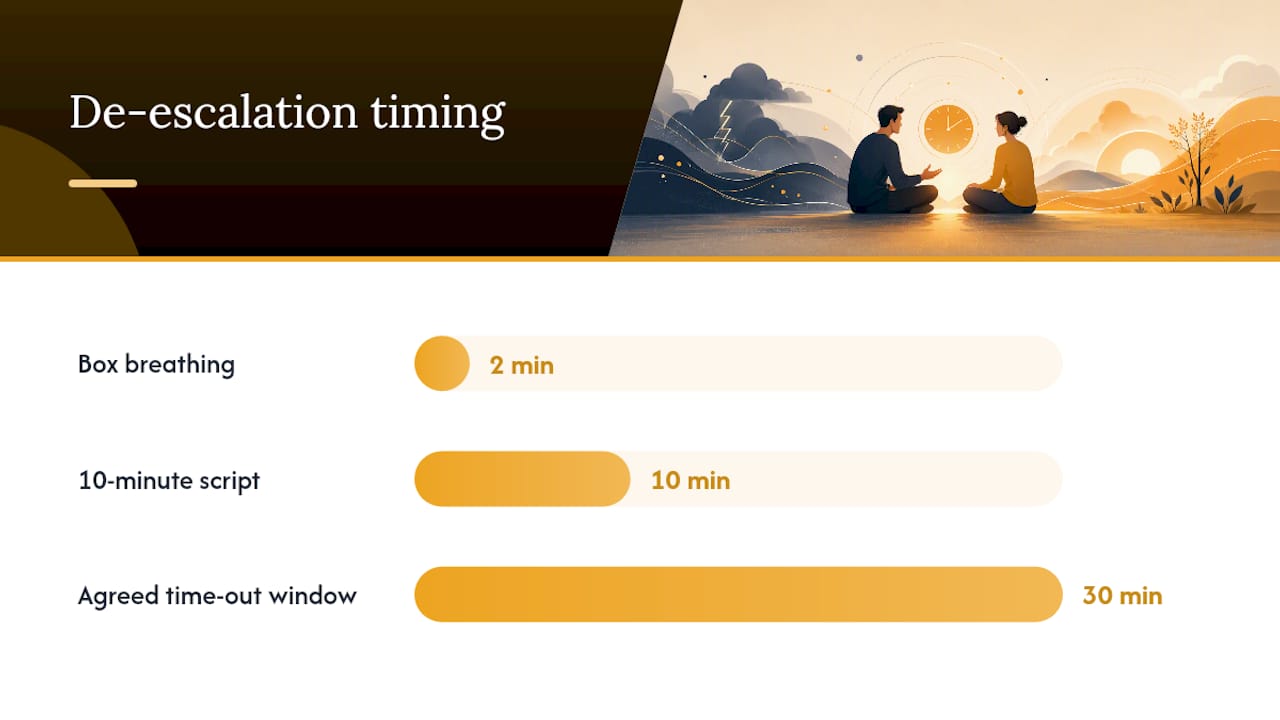
- Set a return time out loud: “Let’s talk again at 8:30.” Vague pauses turn into silent treatment; specific ones turn into repair.
- Use the time to lower your own arousal, not to build your argument.
- Reconvene at the agreed time, even if neither of you feels fully ready. Showing up on schedule rebuilds trust in the process itself.
Therapists who work with high-conflict couples consistently recommend this kind of structured pause. Short time-outs with a set reconvene window prevent what researchers call emotional hijacking, the point where you’re too flooded to think clearly or listen.
During the time-out itself, two grounding techniques do the physiological work fast:
- Box breathing: inhale for four counts, hold four, exhale four, hold four. Repeat for two minutes.
- Body scan: notice where you’re holding tension (jaw, shoulders, stomach) and consciously release it.
Know the signs it’s time to call the pause before someone says something they can’t take back: you’re repeating the same sentence with more volume each time, your voice has raised at least one register, or you notice your shoulders creeping toward your ears. Any one of those is your cue.
Pro Tip: Agree on your time-out phrase and the 30-minute window before you ever need it. Trying to negotiate the terms of a pause while you’re already mid-argument almost never works. Decide it on a calm Tuesday night, not in the heat of Saturday’s fight.
For a longer walkthrough of nonverbal cues and time-out scripts you can adapt to your own relationship, Couplesfightschool’s de-escalation guide breaks down several variations depending on how your particular fights tend to start.
Why Do Couples Argue About the Same Thing Over and Over?
Most recurring arguments aren’t really about the dishes, the money, or who forgot the pediatrician appointment. They’re about a pattern that gets triggered by the dishes, the money, or the appointment. Understanding that pattern is what actually stops the repetition, not winning the specific argument.
The emotional escalator
Picture arguments as floors in a building. Level One is the actual issue: whose turn it is to call the plumber. Level Two is about fairness and effort: “You never handle this stuff.” Level Three is about identity: “You don’t respect my time” or “You don’t see me as a partner in this.” Once you’re on Level Three, nobody remembers or cares about the plumber anymore.
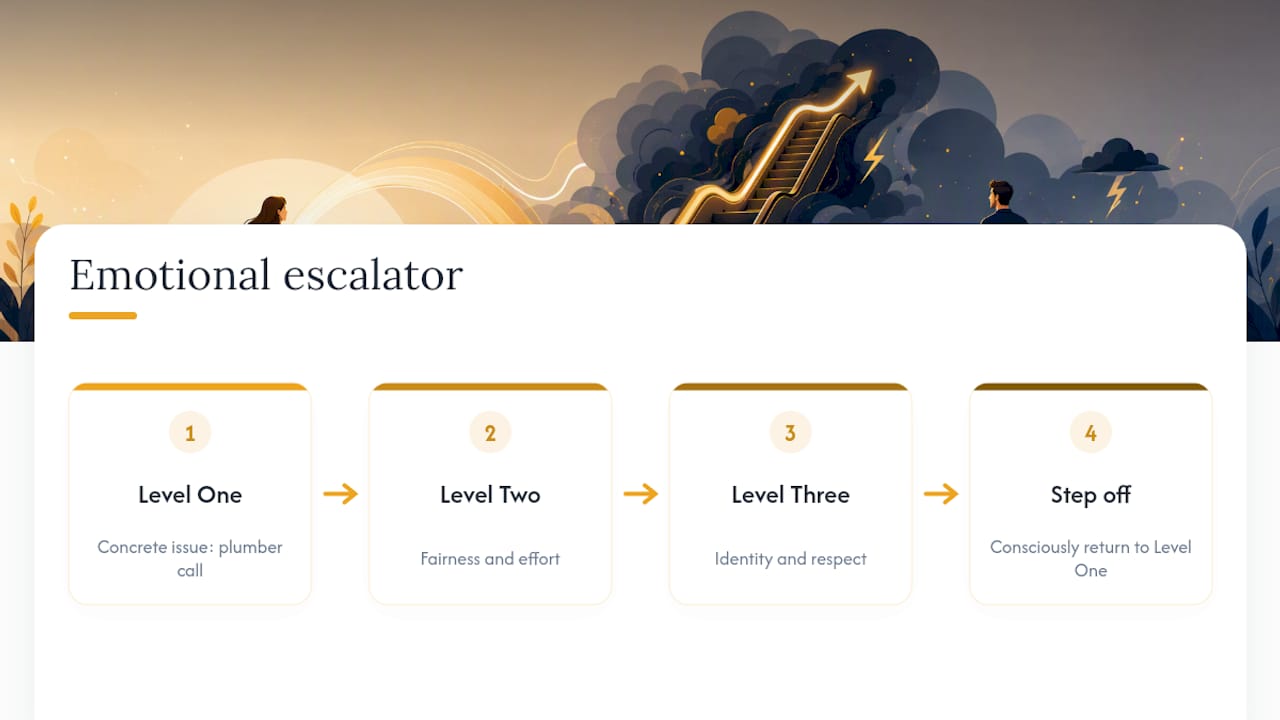
The emotional escalator model explains why couples feel like they’re having “the same fight” even when the subject changes week to week. The subject is never the constant. The climb is.
Stepping off the escalator means noticing which floor you’re on and consciously returning to Level One. That often sounds like: “Let’s back up. This started because we disagree about who calls the plumber. Can we just solve that part?”
The pursuer-withdrawer trap
One partner chases connection or resolution by talking more, asking more questions, pushing for an answer right now. The other partner responds to that pressure by going quiet, leaving the room, or shutting down emotionally. Each behavior makes the other one worse: the pursuer pushes harder because the withdrawer keeps retreating, and the withdrawer retreats further because the pursuit feels overwhelming. Neither person is wrong, exactly. They’re both reacting to the other’s coping style, which keeps escalating in a loop.
If you recognize yourself as the pursuer, the fix isn’t to push harder. It’s to name the pattern and offer space: “I know I get intense when I want to fix this. I’m going to give you twenty minutes, and then I’d like to try again.” If you’re the withdrawer, the fix is signaling that you’re not gone for good: “I need a few minutes, but I’m not walking away from this conversation.”
Selective memory keeps the fight alive
Here’s the part almost nobody talks about: by the time an argument starts, both of you have often already reached a conclusion about the other person’s character, not just their behavior in this instance. Couples frequently enter conflict having already decided the outcome, drawing on a mental file of the partner’s worst past moments rather than a balanced view.
That selective recall is why the same fight about laundry can suddenly include an offense from three years ago. Your brain isn’t being dramatic on purpose. It’s pulling from whatever memory folder got triggered.
The counter to this pattern isn’t complicated, even if it takes discipline. Deliberately naming your partner’s good qualities during calm moments builds a fuller, more accurate mental record. When you’ve spent the week noticing what he did right, one bad Tuesday doesn’t get to define the whole relationship in your mind.
A few small framing habits help catch pre-made conclusions before they take over a conversation:
- Ask yourself, “Am I responding to what just happened, or to a pattern I already expect?”
- Say the assumption out loud: “I’m walking in assuming you’ll get defensive. Is that fair?”
- Give the benefit of the doubt one time before assigning motive.
More on how these escalation cycles form and repeat is covered in Couplesfightschool’s breakdown of the eight most common patterns, which maps several specific versions couples report most often.
How Do You Set Rules for Fighting Fair?
The single most effective shift most couples can make happens nowhere near an actual argument. It happens in a calm conversation where you agree, in advance, on how you’re allowed to fight. Therapists call this meta-communication, essentially, communicating about how you communicate. It sounds almost too obvious to work, but agreeing on ground rules ahead of time creates a shared sense of safety that neither partner has to build from scratch mid-fight.
Building your fight rules
Sit down when you’re both relaxed, not right after a disagreement, and agree on three or four rules together. A workable starter set looks something like this:
- No name-calling or character attacks, even in frustration.
- Either partner can call a time-out using an agreed word or phrase, and the other has to honor it without argument.
- Time-outs last around 30 minutes, and you commit to reconvening at a set time.
- No bringing up unrelated past grievances mid-argument. If something old is bothering you, name it separately later.
- Volume goes down, not up, when either person feels unheard.
Write these down somewhere you’ll both see them again, not just agree to once and forget. A shared note in your phones works fine.
The I-statement template
Most arguments escalate because the opening line sounds like an accusation, even when that’s not the intent. “You never help with bedtime” invites a defensive response almost automatically. Try this structure instead:
“When you [specific behavior], I feel [emotion], and I need [specific request].”
For example: “When you’re on your phone during bedtime, I feel like I’m doing this alone, and I need us to trade off some nights.” Notice this version names a behavior, not a character flaw, and ends with something actionable rather than just a complaint.
Scheduling hard conversations
Timing matters more than most people realize. Bringing up a serious issue at 11 p.m. after a long day, or right as one of you is walking out the door, sets the conversation up to fail before it starts. Ask a simple question first: “Is now a good time to talk about something, or should we pick a time later today?” That single question respects what therapists call your partner’s window of tolerance, the range in which someone can stay present and regulated instead of shutting down or flaring up.
Pro Tip: Keep a running list of recurring friction points, childcare handoffs, money check-ins, chore splits, and schedule a short weekly conversation to address them proactively instead of letting them build until they explode. Couplesfightschool’s repair guide walks through what a scheduled check-in can look like when you want more structure than a kitchen-table chat.
Household-specific fights tend to follow predictable shapes: money arguments are usually about control or security, chore arguments are usually about feeling seen for invisible labor, and childcare arguments are usually about competing definitions of “enough.” Naming which category you’re actually in often shortcuts the whole fight.
What Listening Exercises Actually Improve Communication?
Reading about better communication changes almost nothing on its own. Practicing it in low-stakes moments is what actually rewires how you argue. These drills take fifteen minutes or less and work best done outside of an actual conflict, so the pattern is already familiar when you need it.
- The paraphrase-and-validate drill. One partner talks for 60 seconds about something mildly frustrating, not a major grievance. The other listens without responding, then paraphrases back what they heard in one or two sentences, and asks, “Did I get that right?” Swap roles. Practicing paraphrase with a strict time limit builds the habit of being heard, which lowers reactivity the next time a real disagreement comes up.
- The 10-minute curiosity session. Pick one parked issue you’ve been avoiding. One person talks for five minutes uninterrupted while the other only asks curious, non-defensive questions (“What part of that bothers you most?”). Then switch. No solving allowed during this exercise, just understanding.
- Co-regulation walks. Take a 15-minute walk side by side, ideally holding hands or with some physical contact. Physical closeness during and after hard conversations speeds up nervous-system recovery, which is part of why a “let’s talk while we walk” approach often works better than sitting across a table.
- The micro-win note. After any moment where one of you successfully used a time-out, a paraphrase, or an I-statement instead of escalating, say so directly: “I noticed you paused instead of snapping back. That helped.” Naming small wins out loud makes the new pattern feel worth repeating.
Pro Tip: Do the paraphrase drill about a genuinely low-stakes topic first, like a work frustration, not a relationship issue. You’re building the muscle before you need it under pressure.
For more structured versions of these drills with exact timing and turn-taking rules, Couplesfightschool’s active listening exercises offer several formats depending on how much time you have.
When Should You Consider Couples Therapy or a Structured Program?
Some arguments respond well to better scripts and a calmer approach. Others are a sign that self-guided tools aren’t enough on their own, and that’s worth recognizing rather than pushing through for another year.
Watch for these signals that professional support or a structured program would help:
- Arguments escalate to the same intensity almost every time, regardless of the topic.
- Either partner has made threats, whether about the relationship ending or something more serious.
- One of you consistently avoids conflict entirely rather than engaging, leaving issues permanently unresolved.
- Repair rarely happens: apologies feel hollow, or you both just move on without actually addressing what happened.
- You’ve tried the same fixes repeatedly with no lasting change.
Self-help articles and books are genuinely useful for learning concepts. What they usually can’t provide is repeated practice with feedback and accountability, which is where the gap between knowing what to do and actually doing it under pressure tends to close. Structured coaching and courses that build in repeated practice and accountability tend to move couples from understanding a concept intellectually to actually using it mid-argument, which is a different skill entirely.
A specific framework was built addressing that gap: a stepwise system for communication, emotional regulation, and repair that gives couples scripts to practice rather than just theory to read. The idea is that skills like time-outs, I-statements, and paraphrasing become second nature only after repetition, not after one good conversation.
If you’re evaluating any program, structured or otherwise, ask a few practical questions before committing: Does it include actual scripts and homework, or just concepts? Is there a way to track whether you’re improving over time? Who created it, and what’s their actual background in couples work? A program that can answer all three clearly is worth your time.
The Gap Between Knowing and Doing
Most couples reading an article like this already know, intellectually, that name-calling is bad and that they should “communicate better.” That’s never been the missing piece. The missing piece is repetition under pressure, which is a completely different skill than understanding a concept while calm.
I’d push back on one common assumption: that arguing less means you’re a healthier couple. Some of the most resilient relationships I’ve studied argue plenty. What separates them isn’t frequency, it’s whether repair actually happens afterward. A couple who fights twice a week but reliably reconnects within a day is often in better shape than a couple who never raises their voice but quietly resents each other for years.
Building these skills takes humility, because you will mess up the time-out, snap when you meant to paraphrase, and forget the rules exactly when you need them most. That’s expected, not a sign it isn’t working. Pick one tactic from this article, try it this week, and build from there.
— Carlos
Ready to Practice These Skills With Structure and Support?
If you’ve tried the scripts above and want more than a one-time fix, structured practice is where lasting change actually happens. This approach provides scripts, repetition, and accountability that a single article can’t, without requiring commitment to open-ended traditional therapy first.

For couples who want a focused, guided path, the Stop the Fighting: The Couples Communication & Conflict Resolution Course walks through the exact frameworks covered here, time-outs, meta-communication, escalation patterns, with structured exercises built around the F.I.G.H.T. Plan®. If you’d rather start smaller, the Fight Less Love Again Video Course offers a lower-cost entry point, and couples who want direct, personalized feedback can look into private coaching sessions for real-time practice with a coach instead of working through material alone.
Structured practice speeds up results because it forces repetition on a schedule, rather than leaving new skills to chance the next time a fight starts. Browse the full course and workbook shop to find the format that fits where you’re starting from.
Sources
- 15 Small Ways to Fight Better, According to Couples Therapists
- 5 Simple Ways to Argue Less as a Couple
- How to stop fighting: step off the emotional escalator
FAQ
How Do I Avoid Arguments With My Husband?
Agree on fight rules while you’re both calm, including a time-out phrase and a reconvene window, then use I-statements instead of accusations when a disagreement starts. Naming the escalation out loud (“I notice we’re both getting louder”) often stops a fight before it climbs further.
What Is the 7 7 7 Rule for Marriage?
Definitions of this rule vary across relationship blogs and there’s no single clinical standard behind it, so treat any specific version you find with some skepticism. The consistent theme across most versions is scheduling regular check-ins, weekly, monthly, and longer term, to talk about the relationship outside of conflict.
Why Do Couples Argue So Much?
Recurring arguments usually aren’t about the specific topic (dishes, money, schedules) but about deeper patterns like the pursuer-withdrawer dynamic or selective memory of past conflicts. External stress, work pressure, exhaustion, financial strain, also lowers each partner’s tolerance and makes minor issues escalate faster than they would otherwise.
How Do You Deal With an Argumentative Partner?
Stay on Level One of the argument, the actual issue, instead of matching an escalating tone, and use a calm, pre-agreed time-out phrase if the conversation keeps climbing. If a partner consistently escalates regardless of approach, that’s a signal to consider structured support, such as a conflict resolution course or coaching, rather than continuing to manage it alone.
When Should We Consider Couples Coaching Instead of Self-Help?
If arguments repeat with the same intensity despite trying new scripts, or if repair rarely happens after a fight, structured coaching or a course provides the practice and accountability that reading alone typically can’t. Programs like Couplesfightschool’s private coaching or its Stop the Fighting course are built specifically for that gap between knowing what to do and doing it under pressure.
Recommended
- 10 Minute Conflict Resolution Worksheets for Couples & Clinicians
- Stepparents: 7 Dos and Therapist Scripts to Stop Discipline Fights
- 6 Research Backed Conflict De-escalation Techniques with Ready Scripts
- Six Therapist Backed Communication Exercises Couples Can Do Tonight