
Stop a Fight Tonight: Clinician Backed Emotional Regulation for Couples

When an argument starts to spike, the fastest fix is a shared STOP cue, ten slow breaths, and naming the feeling out loud (“I’m getting flooded” beats silence or a slammed door). This works because it lowers the physical arousal driving the fight and buys both people a real chance to repair instead of just win. Everything below explains how to build that reflex and what to do when it isn’t enough on its own.
TL;DR:
- Building emotional regulation skills involves recognizing physical signs of dysregulation, such as shallow breathing or muscle tension, before behavior escalates.
- Immediate tools like pause-and-breathe, the STOP protocol, and grounding techniques help de-escalate conflicts and should be practiced regularly when calm to become reflexive.
- Structured routines, including weekly check-ins and shared language like safe words and temperature checks, reduce baseline tension and improve co-regulation over time.
- Couples therapy focusing on emotion regulation accelerates progress, especially when early sessions target awareness, acceptance, and impulse control, with specific techniques taught and practiced.
- Professional help is necessary in cases of violence, trauma, persistent loss of safety, or ongoing stalemates, with initial therapy sessions emphasizing assessment and skill-building.
Table of Contents
- What Emotional Regulation for Couples Actually Means
- How Do You Know When a Partner Is Dysregulated?
- Micro-Tools to Stop Escalation in the Moment
- Building Co-Regulation Together: Rituals and Shared Language
- Practice Routines That Make These Skills Stick
- What the Research Says About Targeting Emotional Regulation
- When to Get Professional Help and What Therapy Looks Like
- Meet Carlos Todd and the F.I.G.H.T. Plan®
- The Real Gap in How Couples Are Taught to Fight
- How Couples Fight School® Can Help You Practice This
- Sources
- FAQ
What Emotional Regulation for Couples Actually Means
Emotional regulation for couples is not the same as staying calm all the time. It’s the ability to notice a rising feeling, understand what it’s telling you, and choose a response instead of getting hijacked by it, both on your own (intrapersonal) and together with your partner (interpersonal, sometimes called co-regulation). Research on couples across adulthood treats this as a dynamic process rather than a fixed trait: some people are naturally better at reading their own signals, and both partners’ skills interact to shape how the relationship holds up over time, according to research on emotion regulation in couples.
That interaction matters more than most couples realize. Clinical studies using actor-partner models, which track how one partner’s behavior affects the other’s outcomes, find that ER difficulties like impulsivity, poor emotional awareness, and a thin toolkit of coping strategies predict lower relationship satisfaction for both people involved, not just the person struggling to regulate, per an actor-partner interdependence study. In plain terms: your partner’s bad day with their emotions becomes your bad day too, and vice versa.
Three things worth remembering from that research:
- Emotional regulation for couples is a skill set with distinct parts (awareness, acceptance, strategy, impulse control), not a single “calm gene” some people have and others don’t.
- One partner’s dysregulation reliably drags down both people’s satisfaction scores, which is why couples work targets the pair, not just the “reactive” one.
- Skills here are trainable. Couples in therapy show measurable change in these dimensions across sessions, which is the whole premise behind practicing outside the therapy room too.
Emotional intelligence in marriage isn’t about suppressing frustration or performing patience. It’s closer to weather forecasting: you learn to read the pressure building before the storm hits, and you and your partner develop a shared plan for when it does.
How Do You Know When a Partner Is Dysregulated?
Dysregulation has a body first, a behavior second. Before the words get sharp, most people show physical signs: breathing gets shallow and fast, the chest or jaw tightens, hands go cold, or the stomach knots. If you can catch it there, you have far more options than if you wait for the shouting.
Behaviorally, watch for the repeat-loop (the same accusation said three different ways in two minutes), rising volume, interrupting, or the flip side: going quiet, flat-voiced, or physically turning away. Withdrawal is dysregulation too, even though it looks like calm. A partner who goes silent and stares at the wall may be just as flooded as one who’s raising their voice, just managing it by shutting down instead of escalating.
Use this two-step check when things start heating up:
- Is either person unsafe or triggered past the point of reasoning? If someone is shaking, crying hard, dissociating, or bringing up unrelated old wounds, the nervous system has taken over. Reasoning won’t land right now.
- Can we keep talking productively, or do we need to pause and regroup? If either answer to step one is yes, the conversation needs a break before it needs a resolution.
A quick note on patterns: some research on couples suggests men and women can show different flooding thresholds and different default responses (fight versus withdrawal), but these are tendencies, not rules. Plenty of men shut down and plenty of women escalate first. Don’t diagnose your partner’s gender when you could just ask what’s happening for them right now.
Micro-Tools to Stop Escalation in the Moment
These are the tools you actually reach for mid-argument, not concepts to admire from a distance. Therapist-informed guidance consistently points to breathing, labeling, grounding, and structured pauses as the fastest ways to bring the body’s alarm system back down, according to the Gottman Institute’s work on emotion regulation.
Pause-and-breathe. When you feel your pulse climb, say “I need thirty seconds” and take four counts in, hold for four, out for six. The extended exhale is what actually slows your heart rate, so don’t rush it. A script that works mid-fight: “I want to keep talking about this, but I’m getting flooded. Give me thirty seconds.” That’s it. No accusation, no exit, just a timer.
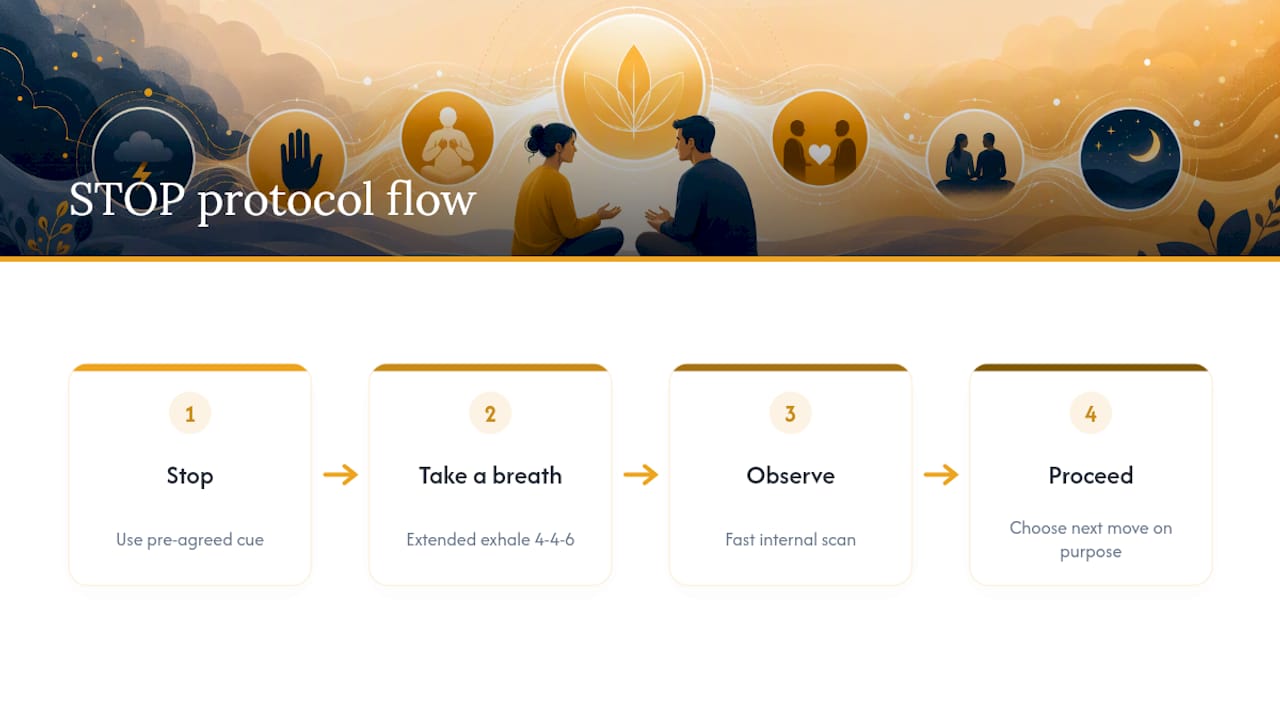
The STOP protocol. This is Stop, Take a breath, Observe, Proceed. Stop means physically pausing, even mid-sentence. Take a breath is the same extended exhale from above. Observe means a fast internal scan: what am I feeling, what does my body want to do, is that urge going to help or hurt? Proceed means choosing your next move on purpose instead of on autopilot. The power of STOP is that it’s a shared cue. When both partners agree on the word ahead of time, saying it becomes an act of care rather than a game of “gotcha,” and both people are far more likely to actually honor it, per Gottman’s conflict-cycle research.
3-2-1 grounding. Name three things you can see, two things you can hear, one thing you can physically feel (the chair under you, your feet on the floor). This yanks your attention out of the spiral and back into the room, which interrupts the threat response your brain is running.
Opposite action. When the urge is to raise your voice, drop it. When the urge is to walk away and never come back, stay in the room but say nothing for a minute. When the urge is to defend yourself point by point, ask one question instead. The technique works because dysregulated urges are usually the least useful response available.
Time-outs that actually work need three rules agreed on in advance, not negotiated mid-fight: a maximum length (twenty to thirty minutes is common), a plan to physically separate without slamming doors or storming out, and a fixed reconvene time stated out loud (“Let’s come back to this at 8:30”). Skipping that last part is why so many time-outs turn into the silent treatment instead of a genuine reset. For more structured scripts you can use word for word, these de-escalation techniques walk through exact phrasing for common flashpoints.
Pro Tip: Practice your STOP word when you’re calm, not during a fight. Say it out loud together once a week for a month, almost like a fire drill, so it feels natural instead of jarring the first time you actually need it.
Building Co-Regulation Together: Rituals and Shared Language
Individual tools handle the moment. Co-regulation is what you build between arguments so there are fewer moments to handle in the first place. Think of it as joint muscle memory: the more you practice regulating together when things are calm, the more automatic it becomes when things aren’t.
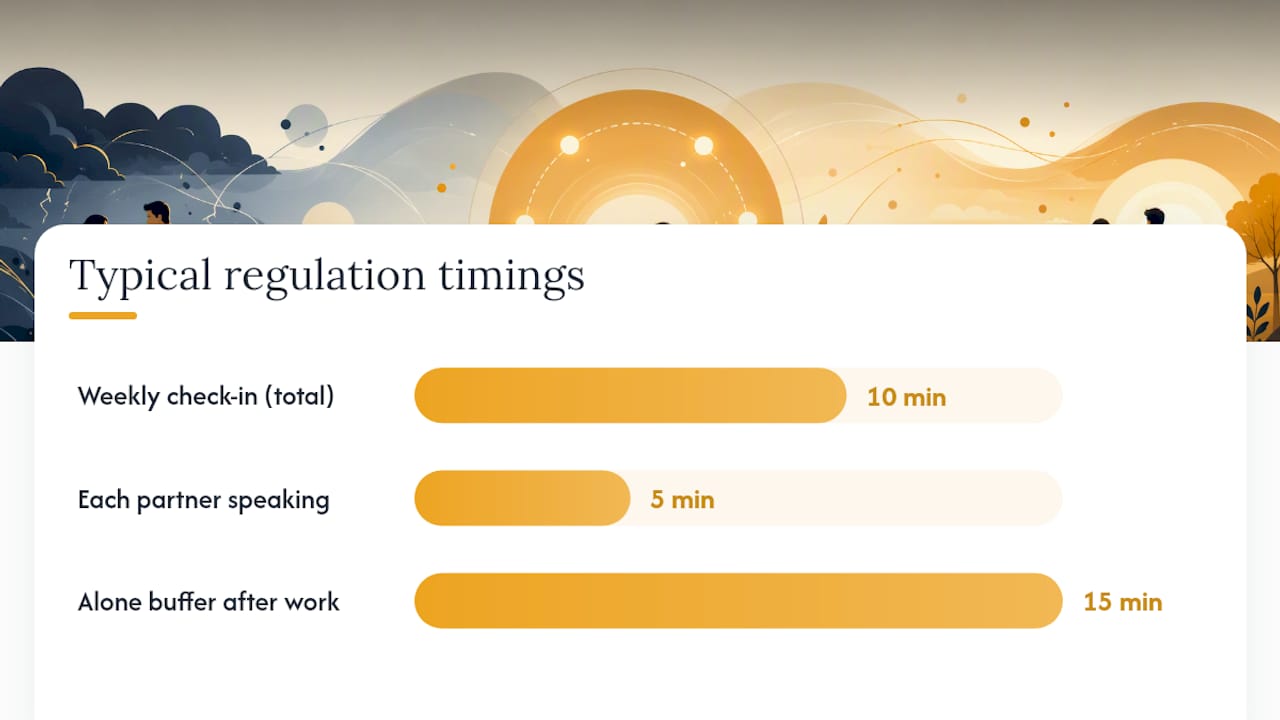
A weekly ten-minute check-in works better than reactive conversations because nobody’s already upset when it starts. Set a fixed time each week. Each partner gets five minutes to answer three prompts: What felt good this week? What felt hard? Is there anything I need from you right now? The listener’s only job is to reflect back what they heard, not solve it, defend it, or one-up it with their own complaint. Set a timer. When the ten minutes are up, stop, even mid-thought.
A stress-reducing conversation borrows structure from Gottman-style approaches: one partner vents about something outside the relationship (work, family, a bad day) while the other listens without offering advice unless it’s requested. The goal isn’t problem-solving. It’s feeling understood, which lowers stress hormones in a way that unsolicited advice usually doesn’t.
Shared language does a lot of quiet work here:
- A safe word or phrase that means “I need to pause” without it being read as abandonment.
- Temperature checks, a quick “where are you at, one to ten?” that lets both people calibrate before things escalate further.
- I-statements (“I felt dismissed when…”) instead of you-statements (“You always…”), which lowers defensiveness because it’s reporting your experience rather than assigning blame.
- Named boundaries, stated plainly and in advance: “I need us to not raise voices in front of the kids,” or “I need fifteen minutes alone after work before we talk about anything hard.”
None of this replaces conflict resolution strategies for the harder conversations. It just means fewer conversations start from a place of alarm. If you want a fuller framework for lowering the baseline tension in your relationship, this four-step approach to fighting less builds directly on these same habits.
Practice Routines That Make These Skills Stick
Skills you only use during a crisis rarely work well in a crisis. The couples who get good at this practice on ordinary days, when nothing is on fire, so the moves are already familiar when something is.
- Two-minute daily breathing together. Sit facing each other, breathe in sync for two minutes, no talking. Awkward at first for almost everyone. Most couples report it stops feeling strange by the end of the first week.
- Name one feeling at dinner. Not “good” or “fine.” A specific word: relieved, irritated, proud, drained. This builds the emotional vocabulary you’ll need mid-argument, when reaching for precise language is otherwise the hardest thing to do.
- A weekly skills session, fifteen minutes. Pick one recent disagreement and role-play it using STOP or an I-statement instead of what you actually said. Swap roles. Give each other one specific piece of feedback: “That landed better” or “That still felt like blame.”
- Track three simple numbers. How often did you use your STOP cue this week? How long did it take to calm down after using it (a rough guess is fine)? On a scale of one to ten, how calm did the conversation feel afterward compared to before you started practicing? These aren’t clinical measurements, just a rough gauge that shows whether the work is landing.
Scaffolding the order matters more than most people expect: start with the low-stakes daily rituals, add the micro-tools once those feel natural, and only then rehearse actual conflict scripts. Jumping straight to role-playing your worst fight tends to backfire before the easier habits are in place.
Pro Tip: Keep a shared note on your phone titled “Our Scripts” with your STOP phrase, your safe word, and two or three I-statements you’ve actually used successfully. When you’re flooded, you won’t remember a script you read once in an article. You will remember one you’ve typed and reread ten times.
What the Research Says About Targeting Emotional Regulation
The case for focusing on emotional regulation isn’t just intuitive, it shows up in outcome data. Studies following couples across adulthood find that specific ER dimensions, meaning awareness of your own emotional state, acceptance of feelings without judgment, having a range of coping strategies, and control over impulsive reactions, are each independently tied to relationship satisfaction, according to research published via the National Institutes of Health.
The actor-partner data adds a sharper point: in a study of clinical couples, difficulties with impulse control, low emotional awareness, and a narrow strategy set predicted lower satisfaction for both the person struggling and their partner, per the actor-partner interdependence model study. One caveat worth sitting with: some markers usually read as “dysregulated,” like a certain kind of emotional nonacceptance, occasionally correlate with higher satisfaction in specific clinical contexts. Emotional regulation isn’t a single dial you turn up to maximum. It’s a set of context-dependent skills, and a couple who never shows any friction isn’t necessarily healthier than one who fights occasionally but repairs well.
Clinically, targeting these dimensions early seems to accelerate progress. Change in emotion regulation across the first several therapy sessions is associated with faster gains in relationship satisfaction, suggesting ER functions as a genuine mechanism of change rather than a side effect of feeling better generally.
Therapy modalities built explicitly around this include:
- Emotion-focused couple therapy, which works directly with attachment-related emotions underneath the surface argument.
- Gottman Method approaches, which combine physiological soothing techniques with structured communication tools like the stress-reducing conversation described earlier.
- Integrative approaches that borrow from cognitive-behavioral traditions to build impulse control and strategy flexibility alongside the emotional work.
Negotiation research outside the couples field backs the same conclusion from a different angle: conflict resolution strategies that emphasize collaboration and managing emotion consistently outperform approaches built around winning the exchange.
When to Get Professional Help and What Therapy Looks Like
Some situations need more than a shared STOP word and a better breathing habit. Get professional support if there’s any violence or fear of violence, an active addiction complicating the conflict, a pattern of the same fight recurring for months with no movement, one partner consistently withdrawing until conversations stop happening at all, or any point where either of you doesn’t feel physically or emotionally safe.
A therapist or coach focused on emotional regulation typically starts with an assessment, sometimes using the same dimensions researchers study (awareness, acceptance, strategies, impulsivity) to figure out where the couple’s specific gaps are. Early sessions usually teach the same category of tools covered here, but with real-time coaching and correction, followed by homework to practice between sessions, and periodic check-ins to track whether satisfaction and conflict frequency are actually shifting.
Before booking, it’s worth asking a potential provider a few direct questions:
- What specific approach do you use for emotional regulation work (emotion-focused, Gottman-informed, something else)?
- What does a typical first month of sessions look like?
- Do you offer in-person, telehealth, or workshop formats, and which do you recommend for our situation?
- How do you track whether the work is helping?
Coaching and therapy aren’t interchangeable. Therapy is appropriate when there’s diagnosable distress, trauma history, or safety concerns. Coaching fits couples who are functioning reasonably well but want structured, guided practice building the skills covered in this guide. If you’re not sure which you need, how to diffuse conflict with your partner is a reasonable starting point before deciding whether to bring in outside support.
Meet Carlos Todd and the F.I.G.H.T. Plan®
Carlos Todd is a licensed mental health professional and co-founder of Couples Fight School® alongside Natasha Pemberton-Todd. His clinical background informs the framework behind Couples Fight School’s core teaching tool, the F.I.G.H.T. Plan®, a structured approach to communication, emotional regulation, and repair built for couples navigating recurring conflict.
The F.I.G.H.T. Plan® isn’t a clinical diagnosis or treatment protocol. It’s a practical framework, closer to a shared playbook than a therapy modality, designed to give couples common language and repeatable steps for the kind of moments covered throughout this guide: catching dysregulation early, using shared cues, and rebuilding emotional safety after conflict. Couples Fight School’s worksheets and courses translate these ideas into exercises you can run on your own schedule, without needing a clinical setting to start practicing. For a deeper look at how emotional safety underpins the whole framework, this guide to emotional safety in relationships explains the concept the F.I.G.H.T. Plan® is built around.
The Real Gap in How Couples Are Taught to Fight
Most advice on managing conflict stops at the concept level: “communicate better,” “listen more,” “stay calm.” Nobody argues with that advice, and almost nobody can act on it mid-fight, because a concept isn’t a reflex. The research on actor-partner effects backs this up in a way that’s easy to miss: it’s not that struggling couples don’t know they should regulate their emotions. It’s that specific, trainable skills, like impulse control and strategy flexibility, are underdeveloped, and no amount of wanting to be calmer builds those skills by itself.
What I’d push back on is the idea that couples therapy is only for relationships in crisis. The data on early-session change suggests ER work moves fastest when it starts before things are dire. Waiting until a relationship is in freefall to learn a STOP cue is a bit like waiting for a house fire to buy a smoke detector.
Prioritize the boring stuff first: the daily two-minute breathing, the shared word you agree on when nobody’s angry. It’s less satisfying than a big breakthrough conversation, but it’s the part that actually changes what happens the next time you’re upset.
— Carlos
How Couples Fight School® Can Help You Practice This
Reading about emotional regulation and actually building the reflex are two different things, and that gap is exactly what Couples Fight School® was built to close. Rather than leaving you to piece together scripts and routines on your own, the F.I.G.H.T. Plan® framework structures the same skills covered here (shared cues, breathing tools, weekly check-ins) into guided courses, worksheets, and coaching you can start using this week.
If you want a self-study option, the conflict resolution techniques couples can practice today module walks through exercises like the ones in this guide with added structure and accountability prompts. If you’d rather work with guided support, online coaching for couples pairs you with real-time feedback as you practice, which tends to help the skills stick faster than self-study alone. Both formats are available, so you can start with worksheets and add coaching later if you decide you want it. Either way, the next step is the same one this article has been building toward: pick one tool, agree on it together, and try it before your next disagreement instead of after.
Sources
The clinical claims in this guide draw primarily from peer-reviewed research on emotion regulation in couples and an actor-partner interdependence study on clinical couples’ satisfaction outcomes. Practical technique guidance comes from the Gottman Institute’s writing on emotion regulation and negotiation-focused conflict resolution strategies from Harvard’s Program on Negotiation. For additional grounded, everyday guidance on emotional intelligence in relationships, HelpGuide’s resource on emotional intelligence is a solid companion read. Couples ready to put these ideas into practice can start with Couples Fight School’s coaching resources.
- Emotion Regulation in Couples Across Adulthood – PMC – NIH
- Emotion dysregulation and couple relationship satisfaction of clinical couples: An actor-partner interdependence model
- 5 Conflict Resolution Strategies That Actually Work – PON
FAQ
What Is the 7-7-7 Rule for Couples?
The 7-7-7 rule is a popular relationship-maintenance habit involving regular check-ins that support the same goal as a weekly emotional check-in, keeping connection consistent instead of reactive.
What Is the 3-6-9 Rule in a Relationship?
There’s no single clinically established rule in relationship research with this name; the phrase circulates informally with varying definitions, often referring to relationship milestones early on. Treat it as a loose guideline rather than a research-backed framework.
What Is the 3-3-3 Rule for Intimacy?
Definitions vary online, but the version most commonly cited suggests checking in on the relationship at three days, three weeks, and three months after a significant event or change, similar in spirit to the structured check-ins described earlier in this guide. It’s a helpful mnemonic more than an evidence-based protocol.
How Do You Handle an Emotionally Dysregulated Partner?
Start with the two-step checklist: confirm whether either of you feels unsafe or triggered, and if so, use a shared STOP cue to pause rather than pushing to resolve things in the moment. Give the pause a fixed reconvene time, and once both partners are calmer, use an I-statement to restart the conversation instead of picking up where the argument left off.
When Should Couples Consider Professional Help for Emotional Regulation?
Seek professional support if conflicts involve violence, addiction, repeated stalemates on the same issue, or a pattern of one partner shutting down entirely, and expect early sessions to focus on assessment and teaching specific regulation tools rather than immediate conflict resolution.
Recommended
- stop the fighting: the couples communication conflict resolution course
- 6 Research Backed Conflict De-escalation Techniques with Ready Scripts