
Imago Dialogue Steps: 10–15 Clinician Backed Scripts for Couples

Imago Dialogue is a structured exchange built on four moves: mirroring, summarizing, empathy, and validation. One partner speaks as the Sender while the other listens as the Receiver, then the roles switch. Couples who practice it consistently report fewer defensive spirals and a stronger sense of actually being heard, which is the whole point of the exercise.
TL;DR:
- Mirroring should be precise and only reflect the partner’s words without adding commentary to avoid sounding robotic and to ensure understanding.
- Summarizing captures the core message after the Sender finishes, helping focus the exchange without misinterpretation.
- Empathy guesses the emotional undercurrent and requires checking for accuracy, fostering genuine understanding rather than assumptions.
- Validation acknowledges the logic behind feelings without agreeing with every detail, helping lower defensiveness in high-conflict moments.
- Setting clear ground rules, timing, and using signals for pauses are crucial to maintain safety and prevent reactivity during structured dialogues.
Table of Contents
- What Are the Imago Dialogue Steps?
- What Ground Rules Keep the Dialogue Safe?
- What Scripts Can You Use in Your First Session?
- What Goes Wrong and How Do You Fix It?
- How Does a Therapist Use This in Real Sessions?
- What Is Imago Dialogue and Why Does It Exist?
- What Happens Between the Core Steps?
- How Does This Actually Improve Communication Long-Term?
- How Should You Prepare Before Starting?
- How Do You Close a Session Well?
- How Do You Keep Practicing Without a Facilitator?
- An Editorial Take on Practicing Imago Dialogue
- How Couples Fight School Can Help You Practice This Consistently
- Sources
- FAQ
What Are the Imago Dialogue Steps?
The Imago Dialogue runs in a fixed order for a reason. Skipping straight to problem solving is what most couples do naturally, and it’s exactly what breaks trust in a hard conversation. The structure forces you to slow down long enough to actually register what your partner said before you react to it.
Step 1: Mirroring
The Receiver reflects back what the Sender just said, in their own words, without adding a rebuttal. Imagoworks frames this as the foundation step, and it typically sounds like: “So what I’m hearing is…” followed by a brief restatement. Then comes the check phrase that keeps the whole thing honest: “Am I with you?”
If the Sender says yes, the Receiver asks, “Is there more?” This loop repeats until the Sender feels fully unpacked. If the mirror missed something, the Sender corrects it and the Receiver tries again. No debating, no adding commentary. Just reflection.
Step 2: Summarizing
Once the Sender has said everything they need to say, the Receiver condenses the whole message into its core point. This is different from mirroring, which happens after each short segment. Summarizing happens once, at the end of the Sender’s turn, and it should capture the essence without injecting new interpretation. Something like: “So the main thing is you felt shut out when I canceled our plans without checking with you first.”
Step 3: Empathy
Here the Receiver guesses at the emotional layer underneath the words. A useful script: “I imagine you might be feeling dismissed, maybe even a little embarrassed.” Then check it, same as before: “Am I close?” The Sender confirms, adjusts, or clarifies. Empathy is a guess, not a diagnosis, and treating it that way keeps the Receiver humble instead of presumptuous.
Step 4: Validation, or the “Gift”
Validation means acknowledging that the Sender’s reaction makes sense given their perspective, without agreeing to every fact or conceding the argument. A typical line: “That makes sense to me, given what happened.” This is often where couples stall, because validation feels like surrender. It isn’t. You’re validating the logic of a feeling, not signing off on a version of events.
Once validation lands, the roles switch, usually decided by mutual check-in rather than a rigid rule. The prior Receiver becomes the new Sender, working through their own piece of the same issue.
What Ground Rules Keep the Dialogue Safe?
Structure only works if both partners agree to it before things get heated. A few nonnegotiables make the difference between a productive exchange and a rehash of the same fight.
- One person sends, one person receives. No interrupting, no crosstalk, no “well actually” mid-mirror.
- Set a rough time limit per turn, five to ten minutes is common, and use a visible timer so nobody feels ambushed by an open-ended monologue.
- Use “Is there more?” as the built-in pacing mechanism rather than guessing when someone is done.
- Get a simple yes before starting. A dialogue sprung on someone in the middle of dinner rarely goes well.
- Agree on a pause signal or safe word ahead of time, something either partner can say to stop the exchange without it counting as giving up.
Ground rules like these matter more than the scripts themselves, because most damage in a hard conversation happens in the gaps between turns, not during them.
Pro Tip: Schedule the dialogue for a specific time instead of launching into it when emotions are already high. “Can we do a dialogue tonight after the kids are down?” beats ambushing your partner at 9 p.m. mid-argument.
Therapist facilitation helps early on, especially for high-conflict couples, because a trained third party can catch reactivity before it derails the exchange and can model what accurate empathy actually sounds like when neither partner has done this before.
What Scripts Can You Use in Your First Session?
Copy-ready language removes the guesswork that stops most couples before they start.
Sender phrases (keep segments short, three or four sentences at most):
- “When you canceled without telling me, I felt overlooked.”
- “I need you to check in with me before making plans that affect us both.”
- “I appreciated how you handled dinner with my parents last week.”
Receiver phrases:
- Mirroring: “So what I’m hearing is…” then “Am I with you?”
- Empathy: “I imagine you might be feeling…” then “Am I close?”
- Validation: “That makes sense to me, given…”
Example one, a conflict: Sender says, “I felt embarrassed when you brought up my job search in front of your family.” Receiver mirrors, checks in, then offers: “I imagine you felt exposed and maybe a little betrayed. That makes sense, especially since we hadn’t talked about who knew.”
Example two, an appreciation: Sender says, “I noticed you made time for me even though work was crazy this week.” Receiver mirrors it back, then adds, “I imagine that meant a lot, like you actually mattered to me despite everything else going on.” Positive exchanges count as practice too, and they’re usually where couples build confidence before tackling harder topics.
A full practice session usually runs 10 to 15 minutes: two or three minutes per Sender turn, a role switch partway through, and a short close where both partners name one thing they appreciated about how the other listened.
What Goes Wrong and How Do You Fix It?
Most breakdowns come from a handful of predictable spots.
- Parroting instead of mirroring. Repeating exact words back can feel robotic and make the Sender feel unheard rather than understood. Shift to capturing the intent behind the words, then check “Am I with you?” to confirm you got it.
- Defensiveness creeping into the mirror. If the Receiver starts editorializing (“So you’re saying I never…”), pause and restate the rule: reflection only, no rebuttal, not yet.
- One partner refusing to participate. Don’t force it. Suggest a shorter version, two minutes each, or revisit the topic when things feel calmer.
- Mid-dialogue reactivity. If either partner’s voice rises or the pace speeds up, that’s the cue to use the pause signal and take a break, not push through.
Progress looks like shorter dialogues over time, fewer corrections during mirroring, and less bracing before you start. If sessions consistently end in escalation rather than resolution, why couples stop communicating effectively is worth reading, and bringing in a therapist is a reasonable next move rather than a failure.
Pro Tip: If you notice yourself rehearsing your rebuttal while your partner is talking, you’ve stopped receiving. Refocus on the exact words and tone, not your response to them.
How Does a Therapist Use This in Real Sessions?
Carlos Todd notes that in time-limited clinical work, Imago-style dialogue earns its place because it gives couples a repeatable structure they can use between sessions, not just during them. Therapists typically model the empathy and validation steps first, since those are where most couples stumble without guidance.
The F.I.G.H.T. Plan® framework complements this kind of dialogue work by addressing what happens before and after the exchange: emotional regulation when things get hot, and repair strategies when a dialogue doesn’t fully land. Structured dialogue alone rarely resolves the deeper wound behind a recurring fight. It’s a tool for slowing down and staying connected while the harder work of healing happens alongside it. Couples who pair a single technique with ongoing coaching or course work tend to see more durable change than those relying on scripts alone.
What Is Imago Dialogue and Why Does It Exist?
Imago theory starts from a specific observation: a lot of what couples fight about in the present is carrying weight from somewhere else, often childhood attachment patterns or old relational wounds. The dialogue itself was designed to slow reactive conversation down enough that partners can access what’s actually underneath a complaint, rather than trading surface-level accusations back and forth.
The purpose isn’t to win an argument or even to solve the immediate problem. It’s to create a moment where one partner feels genuinely understood by the other, which on its own tends to lower defensiveness. Once someone feels heard, they typically stop fighting to be heard, and the conversation naturally opens up.
This matters because most couples default to debate mode the second a disagreement starts. Someone states a grievance, the other person defends or counterattacks, and neither one actually processes what the other said. Imago Dialogue interrupts that pattern by making listening the explicit job of one partner at a time, with no room to multitask between listening and rebutting.
It’s not a fix for every relational problem, and it isn’t a replacement for addressing repeated betrayals or serious trust breaches. It’s a communication tool, specifically built for the moment when a conversation is about to go sideways and both partners still want it to go somewhere useful instead.
What Happens Between the Core Steps?
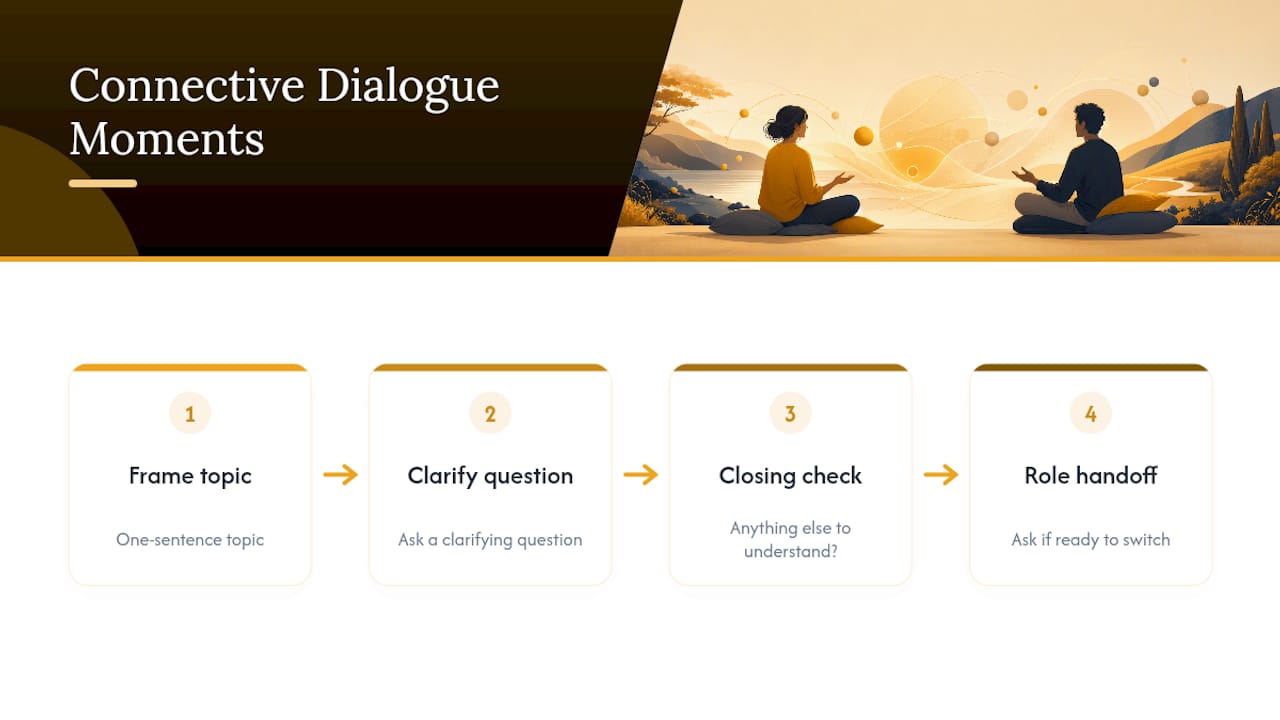
The four core moves get most of the attention, but a full dialogue includes a few connective steps that keep things moving.
Before the Sender starts, there’s usually a brief framing moment: naming the topic in one sentence so the Receiver knows what’s coming. “I want to talk about how we handled the holiday schedule” sets expectations before the emotional content arrives.
Between mirroring and summarizing, the Receiver often asks a clarifying question if something genuinely wasn’t clear, framed as a question rather than a challenge: “When you say you felt dismissed, do you mean in that specific moment or more generally?” This differs from crosstalk because it’s still in service of understanding, not arguing.
After validation, before the role switch, many couples add a brief closing check: “Is there anything else you need me to understand before we switch?” This catches loose threads that would otherwise surface later as a new grievance.
The role switch itself deserves its own moment rather than happening automatically. A quick verbal handoff, “Ready to switch, or do you need a minute?”, respects that the new Sender might need to gather their thoughts, especially if what they just heard stirred something up.
None of this is complicated once you’ve done it a few times. The extra structure just prevents the two or three most common ways a dialogue quietly turns back into a regular argument.
How Does This Actually Improve Communication Long-Term?
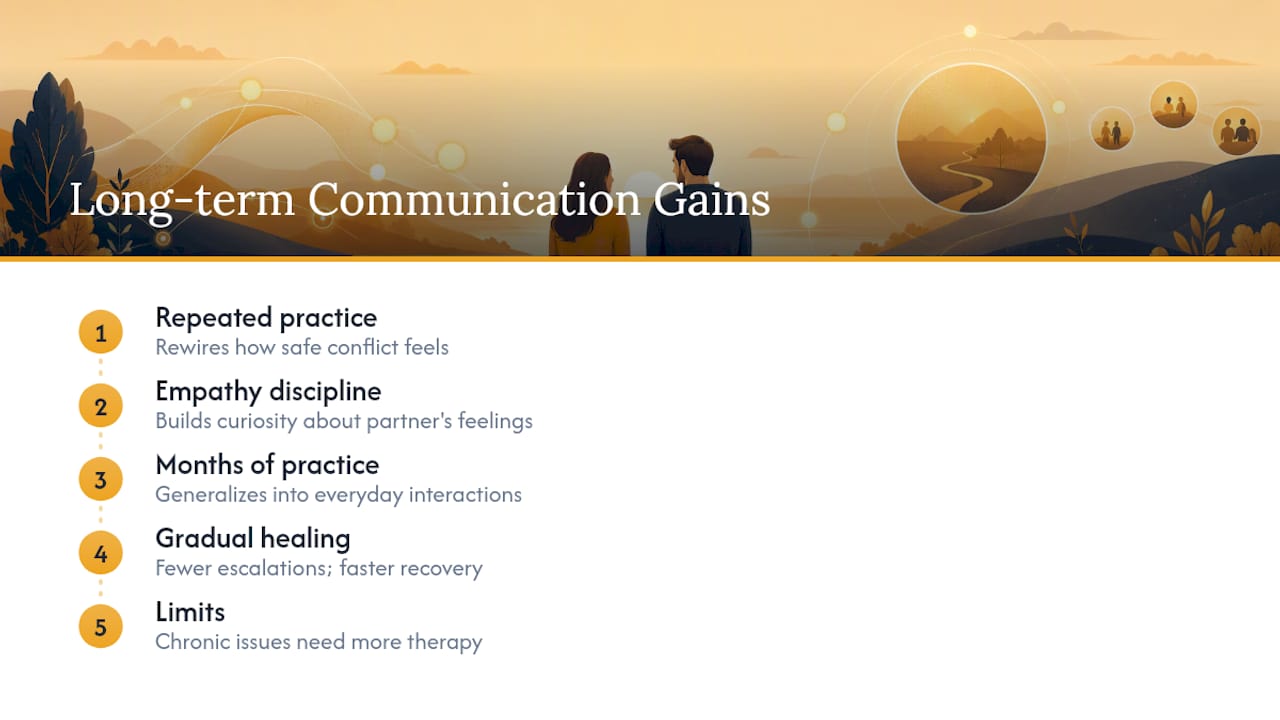
The mechanism is fairly straightforward: repeated practice of being fully heard, without having to defend your position, rewires how safe conflict feels. Couples who dialogue regularly report that ordinary disagreements stop escalating as fast, because both partners have practiced staying in listening mode past the point where they’d normally interrupt.
There’s also a secondary effect that gets less attention. Practicing empathy as a discipline, guessing at feelings and checking accuracy, builds a habit of curiosity about your partner’s inner life instead of assuming you already know it. Over months of practice, that curiosity tends to generalize beyond formal dialogue sessions into everyday interactions.
Healing shows up less as a dramatic breakthrough and more as a gradual shift: fewer conversations that spiral, faster recovery after a rough exchange, and a growing sense that hard topics are survivable rather than something to avoid. For emotional safety to take root in a relationship, both partners need enough repeated evidence that vulnerability won’t be punished, and structured dialogue is one of the more reliable ways to generate that evidence on purpose rather than by accident.
It’s worth being honest that dialogue alone doesn’t heal everything. Chronic issues like infidelity recovery or long-standing resentment usually need more than a communication technique. But as a mechanism for day-to-day repair and connection, it does real work.
How Should You Prepare Before Starting?
A few minutes of setup prevents most early failures. Pick a time when neither partner is exhausted, rushed, or already irritated, right after a stressful workday is rarely ideal.
Agree in advance on which topic you’re addressing. Vague or shifting topics (“let’s just talk about us”) make it hard for the Sender to stay focused and for the Receiver to mirror accurately.
Decide who sends first. Some couples let whoever has the more pressing issue go first; others alternate by default. Either works, as long as it’s agreed rather than assumed.
Physically remove distractions. Phones away, door closed, no half-attention to a show playing in the background. The exercise depends on full presence from the Receiver especially.
Finally, briefly restate the ground rules if it’s been a while since your last dialogue: no crosstalk, use the check phrases, and agree on the pause signal. This thirty-second reset keeps old habits, interrupting, defending, from sneaking back in before you’ve even started.
How Do You Close a Session Well?
A dialogue that ends abruptly, right after the last validation statement, leaves both partners in an oddly suspended state. A short, deliberate close matters as much as the structured start.
Once both partners have had a turn as Sender, take a moment to name one thing you appreciated about how your partner listened. This isn’t required by the formal structure, but it reinforces that the exercise felt safe rather than just clinical.
Check in briefly on how each person is feeling after the exchange. Some people need a few minutes of quiet before transitioning back to normal conversation, especially after a heavier topic. Naming that need out loud (“I need a minute before we talk about dinner”) prevents the awkward whiplash of going straight from vulnerable disclosure to logistics.
If the topic didn’t fully resolve, that’s normal and doesn’t mean the dialogue failed. Agree on whether it needs a follow-up session or whether enough ground was covered for now. Not every issue needs to be fully solved in one sitting, and treating dialogue as a single-shot fix puts unnecessary pressure on it.
End with something concrete: a hug, a specific plan for later, or simply acknowledging that the conversation took effort. Small closing rituals like this signal to both partners that the hard work of listening was worth doing.
How Do You Keep Practicing Without a Facilitator?
Most couples eventually practice without a therapist in the room, and a few habits make that sustainable.
Start with low-stakes topics before attempting a dialogue about your biggest recurring fight. Practicing on something minor, how chores get divided, what to do this weekend, builds muscle memory for the structure before you need it under real pressure.
Set a regular check-in rhythm, even fifteen minutes weekly, rather than only reaching for dialogue when a fight is already brewing. Couples who treat it as maintenance rather than crisis response tend to stick with it longer.
Keep a shared note, physical or digital, with your agreed-upon scripts and ground rules. Under stress, people forget structure they know perfectly well when calm. Having the phrases written down removes that friction.
If a dialogue keeps derailing at the same step, mirroring, usually, that’s useful information rather than a sign to quit. It often means one partner needs more practice slowing down before responding, which a structured course or a few coached sessions can address directly. Self-practice works well for maintenance; it has limits for couples working through deeper, recurring conflict patterns.
An Editorial Take on Practicing Imago Dialogue
Most guides oversell the scripts and undersell the discipline required to actually stay in the Receiver role. The phrases themselves are simple. Sitting quietly while your partner says something that stings, and mirroring it accurately instead of defending yourself, is the hard part, and no script fixes that on its own.
The conventional advice treats mirroring as the whole exercise. It isn’t. Validation is where couples actually change something, because it requires acknowledging your partner’s logic without needing to win the underlying argument. Couples who skip straight to empathy without genuinely validating first tend to stall, because empathy without validation can feel like being psychoanalyzed rather than heard.
If you’re starting today, prioritize getting comfortable with silence during the Sender’s turn before worrying about perfect phrasing. Everything else in the structure gets easier once you’ve built that one habit.
— Carlos
How Couples Fight School Can Help You Practice This Consistently
Reading through the steps is one thing. Staying steady in the Receiver seat during an actual argument, with your partner’s voice raised and your own defenses climbing, is another. That gap is where guided coaching earns its keep over solo practice: a coach catches the moment mirroring slides into rebuttal and resets it before the whole exchange derails.

Couples Fight School® offers online coaching for couples built around exactly this kind of structured practice, alongside the F.I.G.H.T. Plan® course for couples who want a full framework rather than a single technique. These resources are developed by mental health professionals familiar with where scripts can break down under real pressure. If dialogue practice encounters common obstacles like parroting instead of mirroring or partner shutdowns mid-exchange, coaching may help identify and address these patterns. Start by booking a session through Couplesfightschool and bring your hardest recurring topic to the first one.
Sources
This article is general information, not a substitute for advice from a qualified doctor. Consult a qualified healthcare professional about your own circumstances before acting on anything here.
FAQ
What Is Intentional Dialogue?
Intentional dialogue is another name for the Imago Dialogue process, a structured Sender and Receiver exchange built on mirroring, validation, and empathy that slows down reactive conversation so both partners feel heard.
What Are the Core Principles of Imago Therapy?
Imago therapy is built on the idea that many present-day conflicts carry weight from earlier relational wounds, and that structured dialogue, rather than free-flowing debate, helps couples access and address that deeper layer instead of just the surface complaint.
What Are the Criticisms of Imago Therapy?
Critics note the structured format can feel rigid or slow for couples who prefer a more natural conversational style, and that it works best with consistent practice or therapist facilitation rather than as a one-time fix for deep-seated conflict.
How Does Imago Therapy Differ From the Gottman Method?
Imago Dialogue centers on a specific turn-based script with defined Sender and Receiver roles, while Gottman-based approaches focus more broadly on identifying conflict patterns and building general relationship skills like repair attempts and shared meaning. Couples Fight School’s F.I.G.H.T. Plan® draws on structured techniques from both traditions.
Recommended
- 6 Research Backed Conflict De-escalation Techniques with Ready Scripts
- 9 Step Partner Anger Debrief: Ready Scripts and F.I.G.H.T. Plan®
- 10 Minute Conflict Resolution Worksheets for Couples & Clinicians