
90 Day Psychological Safety Plan for Married Couples

Psychological safety in marriage means both partners can say what they actually feel, admit a mistake, or ask for what they need without bracing for punishment. It exists on a spectrum, not a switch, and it’s built or rebuilt through repeated, ordinary behavior rather than one big gesture. If your marriage feels tense right now, the first move isn’t a heart-to-heart. It’s asking permission: “Can we talk about something that’s been bothering me?”
TL;DR:
- Small, consistent behaviors like asking permission before difficult talks and following through on promises are key to building emotional safety.
- Recognizing signs like self-censoring, withdrawal, and contempt helps identify when a marriage lacks psychological safety, especially if threats to the relationship are present.
- Trust is essential for safety, and even minor betrayals or broken promises can erode trust, requiring accountable, observable actions to rebuild.
- Past traumas often trigger exaggerated reactions during conflict, making trauma-informed therapy vital for addressing these old patterns.
- Professional support should be sought early if violence or retraumatization occur, as timely intervention improves the chances of restoring safety and trust.
Table of Contents
- What Is Psychological Safety in Marriage, and Why Does It Matter?
- What Are the Signs Your Marriage Lacks Emotional Safety?
- How Do You Build Psychological Safety in Your Marriage?
- How Do You Rebuild Trust After a Breach?
- When Should You See a Couples Therapist?
- The Role of Trust in Establishing Psychological Safety Within Marriage
- How Do Past Traumas Affect Psychological Safety in a Relationship?
- How Do You Share Vulnerable Feelings Without Feeling Exposed?
- What Are the Biggest Myths About Psychological Safety in Marriage?
- Progress Isn’t Linear, and That’s Normal
- Where to Start With Couples Fight School
- Sources
- FAQ
What Is Psychological Safety in Marriage, and Why Does It Matter?
Psychological safety in marriage is the felt sense that you can be honest, imperfect, or vulnerable with your spouse and the relationship will hold. You’re not rehearsing your words for damage control. You’re not scanning your partner’s face for a mood shift before you speak.
That feeling has a biological signature. When a spouse senses threat, real or perceived, the nervous system shifts into fight, flight, or shutdown, and calm conversation becomes physically difficult. CNN’s coverage of relationship experts describes how threat responses hijack communication long before either partner says a harmful word. Emotional safety in marriage works the opposite way: consistent tone, presence, and follow-through signal to the body that it’s safe to stay engaged instead of shutting down.
This is why couples who feel psychologically safe recover from arguments faster. They don’t avoid conflict. They fight, then repair, then move on without the fight becoming evidence in some ongoing case against each other. That recovery speed, more than the absence of disagreement, is what separates resilient marriages from ones that slowly go numb.
What Are the Signs Your Marriage Lacks Emotional Safety?
Unsafe marriages have a distinct texture. Partners describe walking on eggshells, or rehearsing sentences before saying them out loud. Watch for these patterns:
- Self-censoring: You edit your thoughts before speaking because you’re predicting your partner’s reaction.
- Stonewalling: One or both of you shut down mid-conversation instead of engaging, a classic sign the nervous system has hit overload.
- Contempt: Eye-rolling, sarcasm, or mockery that communicates disgust rather than frustration.
- Shame spirals: Bringing up a flaw doesn’t lead to a conversation, it leads to one partner feeling fundamentally bad about who they are.
- Withdrawal: Physical or emotional distance becomes the default response to tension.
- Threatening the relationship itself: Saying things like “maybe we shouldn’t be together” during an argument.
That last one deserves special attention. The Institute for Family Studies identifies commitment safety, the shared belief that the relationship has a future, as one of the core pillars holding a marriage together. Every time a partner threatens to leave mid-fight, even as a rhetorical jab, it chips at that pillar and makes the next vulnerable conversation harder to start.
How Do You Build Psychological Safety in Your Marriage?
Building safety isn’t about grand romantic gestures. It’s about small, repeatable behaviors your spouse’s nervous system learns to trust over time. Here’s a sequence that works for most couples, starting with the lowest-friction changes first.
- Ask consent before hard conversations. A simple line like “Is now an okay time to talk about something?” hands your partner control over timing, which lowers defensiveness before you’ve even said the real thing.
- Agree on a timeout signal. Pick a word or gesture either of you can use to pause a conversation that’s escalating, with a commitment to return to it within an agreed window, not to disappear.
- Practice reflective listening. Repeat back what you heard before responding: “So you’re saying you felt dismissed when I checked my phone.” This single habit slows the pace of an argument and proves you were actually listening.
- Show up in small, boring, reliable ways. Text when you say you will. Follow through on the small promise. Behavioral consistency is what convinces a wary nervous system that safety is real, not performed.
- Use co-regulation tools when things get hot. Slow your breathing, lower your voice, or physically move to a different room. Sometimes switching to a text message or written note works better than talking face-to-face when emotions run high.
- Hold boundaries without weaponizing honesty. You can say “I need space right now” without it becoming “you always suffocate me.” Directness and cruelty are not the same skill.
- Repair micro-harms immediately. A short, specific apology right after a slight, followed by one visible corrective action, does more for diffusing conflict than a long apology delivered three days later.
Pro Tip: Keep your timeout signal absurdly simple, a single word like “pause” works better than a phrase. Under stress, complicated systems fail; simple ones survive the moment you actually need them.
How Do You Rebuild Trust After a Breach?
Rebuilding after infidelity, repeated contempt, or ongoing harm follows a different order than everyday maintenance. Containment comes first: no blame-shifting, no minimizing, no rushing the hurt partner toward forgiveness on your timeline.
From there, the couple needs an actual repair plan, not vague promises. That means transparency measures both partners agree to, scheduled check-ins, and specific, observable actions rather than abstract commitments to “do better.” A rebuild plan works best when it specifies measurable behaviors, daily check-ins, verified transparency steps, and a plan for what happens when either partner slips.
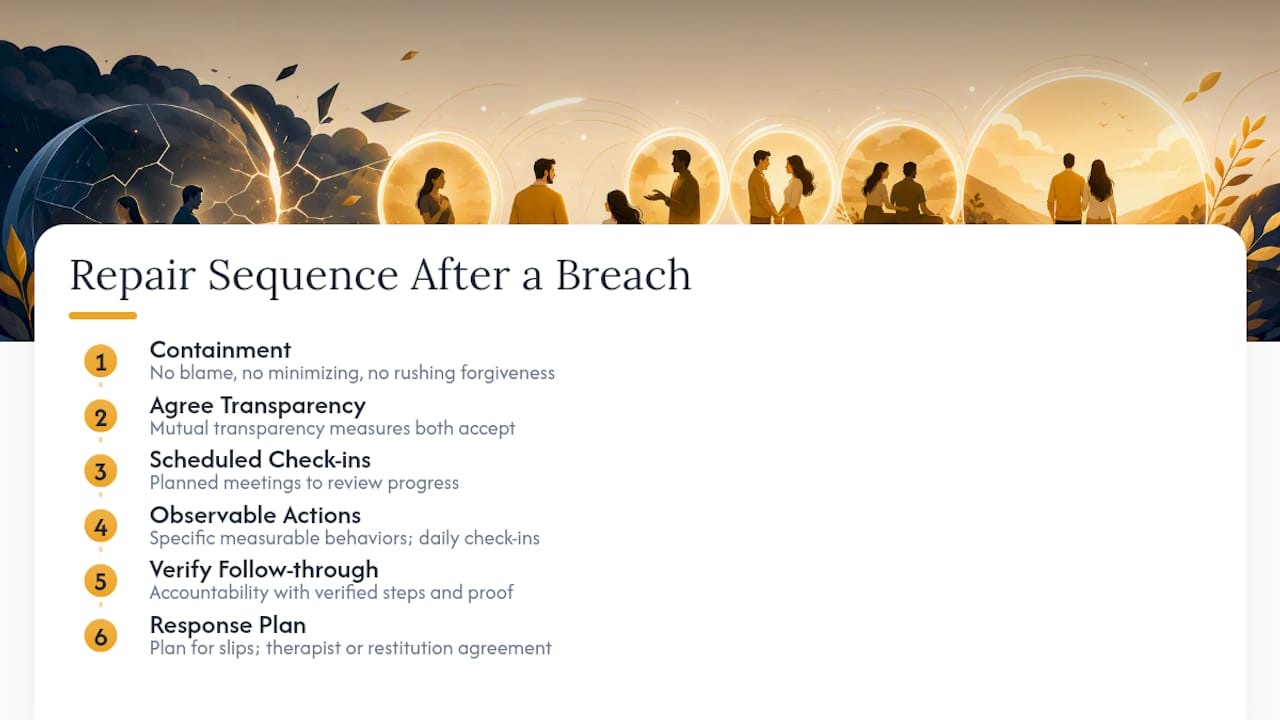
Consistency outperforms grand gestures here every time. A weekend away won’t undo months of broken trust, but ninety straight days of doing what you said you’d do will start to. Expect setbacks. Trust rebuilding rarely moves in a straight line, and rebuilding it usually takes considerably longer than the breach itself took to happen. When the harm involved betrayal or repeated cycles neither partner can break alone, a therapist-facilitated repair process or a written restitution agreement gives the work structure that willpower alone can’t provide.
When Should You See a Couples Therapist?
Some situations call for professional support immediately, not as a last resort: physical violence, ongoing retraumatization, or a destructive cycle neither partner can interrupt no matter how hard they try.
Several evidence-based approaches build safety directly. Emotionally Focused Therapy (EFT) targets attachment wounds and has strong outcomes for building security between partners. Systems theory treats the couple as one interacting unit rather than two individuals in conflict. Trauma-informed care accounts for how past wounds shape present reactions.
When choosing a clinician, ask about their approach directly and expect the first sessions to focus on stabilizing safety, not diving into the deepest wound. Couples who wait years before seeking help tend to see lower success rates than those who reach out earlier.
The Role of Trust in Establishing Psychological Safety Within Marriage
Trust and psychological safety aren’t the same thing, but one can’t exist for long without the other. Trust is the belief that your partner’s actions will match their words. Safety is what that belief produces: a nervous system that can relax instead of staying on alert.
The Institute for Family Studies breaks this down into several distinct types of safety, and commitment safety anchors the rest. When you believe your marriage has a future, you take more emotional risk inside it. You bring up the resentment instead of burying it. You admit the fear instead of pretending it isn’t there. Without that anchor, every disclosure feels like a gamble that could end the relationship rather than deepen it.
This is why small trust violations, a lie about spending, a broken small promise, do outsized damage. They don’t just hurt in isolation. They quietly change the math a partner runs before deciding whether to be vulnerable next time. Rebuilding that math takes accountability paired with visible follow-through, sustained long enough that the wary partner’s brain updates its prediction.
Trust also runs in both directions, and this gets missed often. A partner who never trusts themselves to handle their spouse’s honesty, who panics or over-reacts every time something hard comes up, erodes safety just as much as the partner who lied. Building trust means becoming someone who can hear hard things without falling apart, not just someone who tells the truth.
How Do Past Traumas Affect Psychological Safety in a Relationship?
A spouse’s history doesn’t stay in the past. It shows up at the dinner table during an ordinary disagreement about money or chores. Someone who grew up walking on eggshells around an unpredictable parent may read a raised eyebrow as the start of a blowup, even when nothing dangerous is actually happening.
This isn’t a character flaw. It’s a nervous system doing exactly what it learned to do to survive an earlier environment. The trouble is that the same wiring built for protection back then often misfires now, interpreting a spouse’s normal frustration as the same danger a childhood caregiver’s anger once represented.
Couples often mistake this for incompatibility when it’s actually an old alarm system firing in a new context. A partner who shuts down completely during conflict, or one who escalates instantly and disproportionately, may be responding to their trauma history more than to the actual disagreement in front of them.
Naming this pattern out loud, without using it as either an excuse or a diagnosis, changes the dynamic. Saying “I think I’m reacting to something older than this conversation” gives both partners room to slow down. Trauma-informed therapy approaches specifically address these triggers, helping a partner separate the current moment from the old threat their body is replaying. Ignoring this piece of the picture means couples keep fighting the same fight with new words, never realizing one person’s nervous system was reacting to a memory the other person can’t see.
How Do You Share Vulnerable Feelings Without Feeling Exposed?
Sharing something tender works differently than airing a grievance, and treating them the same way backfires constantly. A grievance says “you did something.” A vulnerability says “here’s something true about me that scares me to say out loud.”
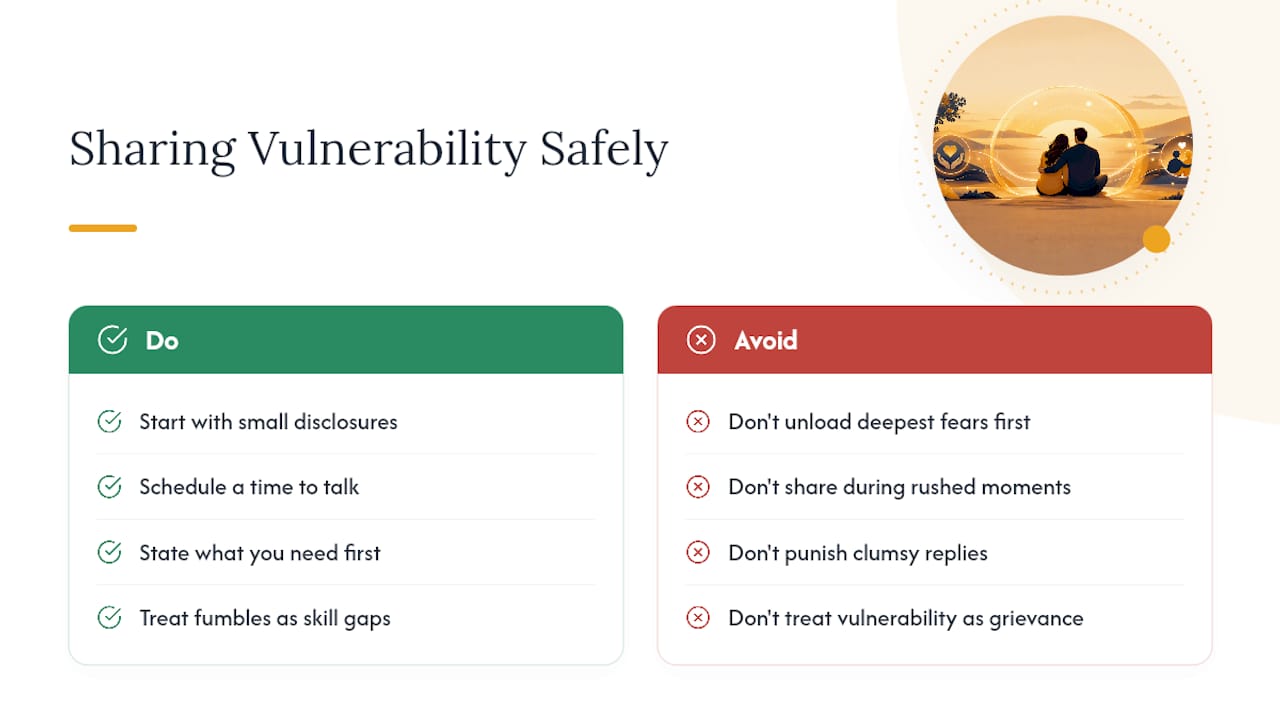
Start smaller than feels natural. Disclosing a minor insecurity and watching your partner respond well builds the evidence base for disclosing a bigger one later. Trying to unload your deepest fear in the middle of your first vulnerable conversation in months usually backfires, because neither partner has built the muscle to handle it yet.
Timing and setting matter more than most couples realize. A vulnerable disclosure dropped during a car ride five minutes before a work meeting lands very differently than the same words shared on a quiet evening with no clock running. Ask for the conversation in advance when you can: “I want to tell you something that’s a little hard for me, can we find twenty minutes tonight?”
Name the ask directly. Say what you need from your partner before you start talking, whether that’s “I just need you to listen” or “I want your advice on this.” Partners often respond wrong not from lack of love but from guessing wrong about what was actually being requested.
Expect an imperfect response and don’t punish the attempt. If your spouse fumbles their reaction to something vulnerable you shared, treat it as a skill gap, not proof the relationship is unsafe. Punishing an honest but clumsy response teaches your partner to stop trying, which is the opposite of what builds emotional safety in relationships over time.
What Are the Biggest Myths About Psychological Safety in Marriage?
Myth: Safe marriages don’t fight. Some of the most emotionally safe couples argue often. What matters isn’t the frequency of conflict, it’s whether both partners trust the relationship will survive it.
Myth: Safety means always agreeing. Real safety includes room for disagreement without either partner treating dissent as betrayal. A marriage where one partner can’t voice a different opinion isn’t safe, it’s quiet.
Myth: One big romantic gesture can restore trust. Grand gestures feel good in the moment, but the nervous system responds to patterns, not peaks. A single elaborate apology dinner won’t undo six months of broken promises.
Myth: If it’s not verbal abuse, it’s not a safety problem. Chronic sarcasm, silent withdrawal, and constant eye-rolling do real damage even without a raised voice. Contempt is corrosive whether it’s loud or quiet.
Myth: Emotional safety is one partner’s job to provide. Safety is co-created. A partner who consistently shows up honestly while receiving nothing back is doing labor, not building a shared foundation.
Progress Isn’t Linear, and That’s Normal
Couples building psychological safety usually take two steps forward and one step back, not a clean climb. That’s not failure, that’s how nervous systems recalibrate. Track small, observable wins instead of waiting to feel completely different: did you both use the timeout signal correctly this week, or catch a moment of contempt before it landed?
Durable change almost always requires both partners participating, not one person doing all the emotional labor while hoping the other eventually catches up.
— Carlos
Where to Start With Couples Fight School
If you want structure instead of guessing your way through this, this platform offers scripts, timeout systems, and accountability tools described above, developed by licensed clinicians rather than assembled from general advice. A structured framework walks you through consent-based conversation starters, reflective listening drills, and repair steps for the moments you just fought about something small and don’t know how to fix it.
Start with something low-commitment: the emotional safety guide or a short lesson from the couples communication and conflict-resolution course before deciding whether coaching makes sense. If your situation involves a deeper breach or a pattern you can’t break alone, book a session with our relationship coaching team and get a plan built around your specific history, not a generic script.
Sources
- 163 – How Emotional Safety Transforms Your Marriage | USU
- Safety and Successful Marriages | Institute for Family Studies
- Is your relationship emotionally unsafe? Experts explain the signs and what to do — CNN
This article is general information, not a substitute for advice from a qualified doctor. Consult a qualified healthcare professional about your own circumstances before acting on anything here.
FAQ
What Is Psychological Safety in Marriage?
Psychological safety in marriage is the felt sense that you can express honest thoughts, admit mistakes, or show vulnerability without facing punishment, ridicule, or withdrawal from your spouse. It’s built through consistent, small behaviors rather than a single conversation or gesture.
How Do I Give My Wife Emotional Safety?
Start by asking for consent before hard conversations, practice reflective listening so she feels heard rather than managed, and follow through consistently on small promises. Emotional safety comes from behavioral reliability over time, not from one perfect conversation.
Can Psychological Safety Be Rebuilt After Infidelity?
Yes, though it typically takes longer to rebuild than the original breach took to happen. Rebuilding requires accountability, transparency, consistent check-ins, and measurable behavioral changes, often with structured support from a therapist trained in trauma-informed or attachment-based approaches.
What’s the Difference Between Emotional Safety and Trust?
Trust is the belief your partner’s actions will match their words. Emotional safety is the nervous-system state that belief produces, the ability to relax and be open instead of staying on guard.
When Should a Couple See a Therapist for Safety Issues?
Seek professional help immediately if there’s violence, ongoing retraumatization, or a destructive cycle neither partner can interrupt alone. Waiting years to seek support tends to lower the odds of successful repair, so earlier intervention generally produces better outcomes.
Recommended
- Marriage and Divorce: A Practical Guide to Saving Your Relationship
- Create a Shared Vision for Marriage: A Practical Guide
- How to Convince Spouse to Take Marriage Course with You